a Fictionless Man lurks within you
Stay vigilant!


Last week I attended the launch for author/poet Souvankham Thammavongsa’s new novel, Pick a Colour, at the Toronto Reference Library. I came in with high expectations—having enjoyed many of Thammavongsa’s short stories and past interviews—and she did not disappoint. Her speech, like her written word, flitted gracefully from a mischievous smirk to heartfelt poetry and back again, sending ripples through the room as we sat up a bit straighter and shook our heads.
Regrettably, the host who shared Thammavongsa’s stage lacked anything close to the same passion for her medium. By the end of the conversation, his questions (sampled below) were met with audible groans from the crowd. Thammavongsa’s dignified responses, meanwhile, inspired fervent applause—a show of respect perhaps amplified by our collective exhale before the next question arrived.
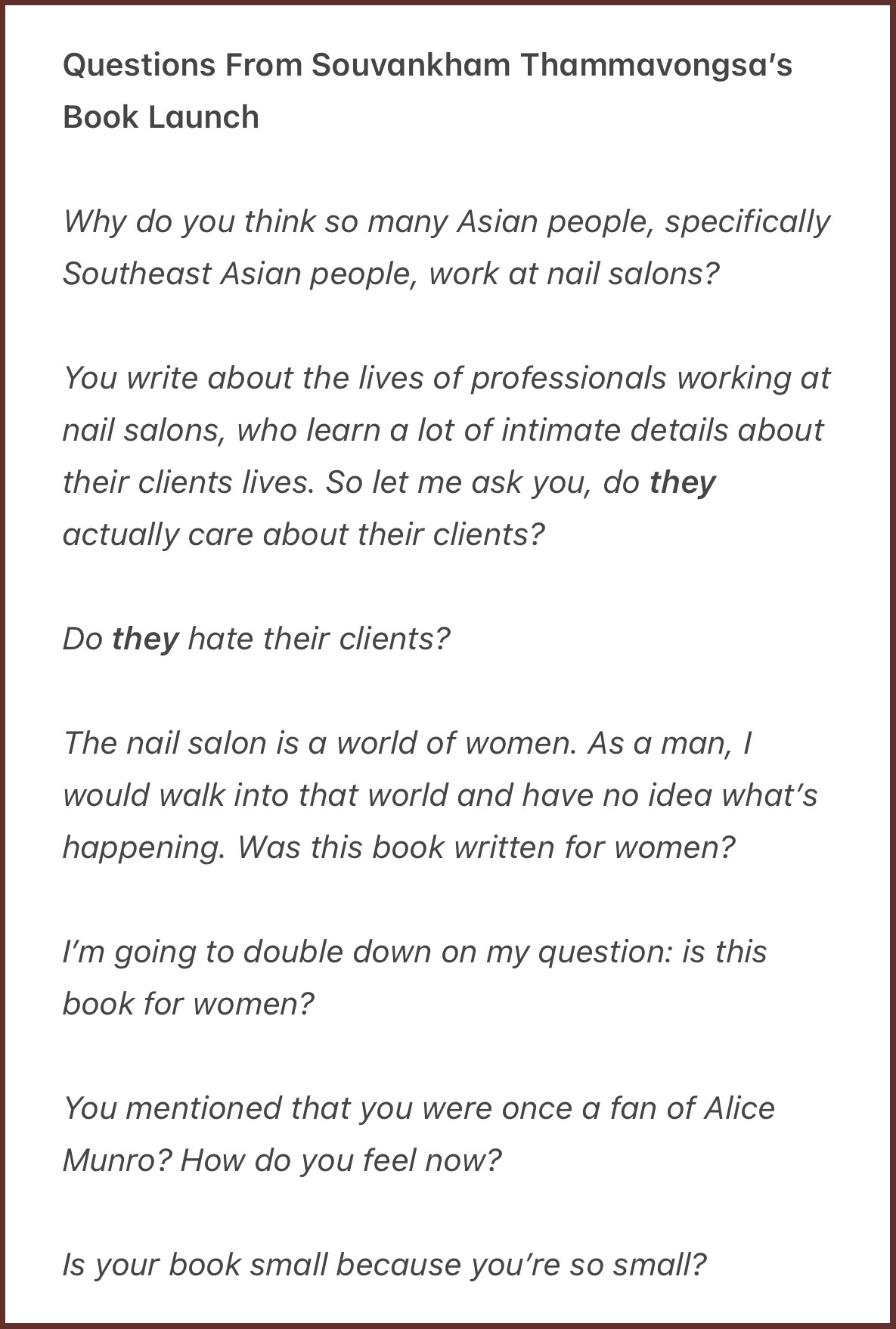
What stuck with me from the event, more than anything else, was not the host’s questioning (he was out of his element and trying his best). It’s not that he was a white male, or a boomer, or that he traveled to the event from his cottage in a car whose seats, I imagine, are of a supple leather (though he might insist such details are what this letter is about). The most revealing moment was his throwaway comment early in the Q&A, paraphrased below:
Host: I should let you know from the get-go, and somewhat sheepishly, that I never read fiction, but I’m really glad to have been chosen to host this event—it finally gave me an excuse to!
The butterflies set in with this opening admission, and my stomach did not unclench until he left the stage. The dissonance of the interview has stuck with me for over a week, inspiring a sensibility I now wish to exorcise: a clumsy caricature sweeping the globe, whom I’ll title the Fictionless Man.
It should first be clarified that the Fictionless Man (FM from here on out) is not quite so simply a man who does not read fiction. In fact, it would be very FM-pilled to interpret the name so literally. The FM need not be a person who identifies as a man (though he often is) nor is he necessarily a person who doesn’t read fiction (though he often doesn’t).
The guiding principle of the FM is a rejection of uncertainty. Unsolved questions floating in the ether are like mosquitoes buzzing in his ear; he strikes them dead with any one of his doubt-eradicating tools. AI chatbots have improved his proficiency at this task, though many FMs find even the chatbots too balanced and verbose, opting instead for their oldest, trustiest categories of world-minimization: economics (supply, demand) and identity factors (race, religion, sexuality, gender). The FM’s capacity for framing problems under these two umbrellas should not be trivialized; the solutions such framing generates are more coherent, and actionable, than those foolishly drawn from poets or academics, who insist on expanding the world he is trying to narrow. The clarity of his output makes the FM indispensable to corporations, and society more broadly.
The FM does not like being challenged by art. He questions, and is baffled by, the merit awarded to “high art”, a category that tends to lack a clear thesis, or—worse—has a thesis that vaguely contradicts his personal project. He thinks it foolish to continue toiling after anything that AI can produce as well as humans, including art, because the humanity that makes art art is not a critical factor in his assessment of art. Like anything else the FM accepts into his life, the art he embraces serves a productive purpose.
Returning to last week’s book launch. Most of the questions or statements the host brought to Thammavongsa were a thinly-veiled “tell us the actual point of your art. Is it about Race? Diaspora? Gender? Exploitation of immigrants? He was begging for a reductive headline, oblivious to fiction’s pursuit of the opposite; it excavates and widens, unveiling context from which any such themes may (or may not) emerge. Of course, starting an analysis from the bottom-up—with individuals—is too unwieldy for a FM. Individuals take entire novels to explain, which he has already told us he does not have time for.
Invisibility is a recurring word in the buzz around Thammavongsa’s new novel, referring to our failure to see, in this case, the people who do our nails (or deliver our UberEats, or wash our dishes). Where the pace of daily life detaches us such that we cast individuals as categories, or productive units, allowing us to treat them with subtle (or not so subtle) indifference, fiction steps in to prolong our attention away from ourselves. It discourages solipsism by helping us carry the work of seeing the subjectivity of others into real life. The fictionless host did not realize that his questions—each an attempt to flatten Thammavongsa’s round characters—were precisely, and ironically, the invisible-izing force her fiction resists. Each of her responses was a graceful refutation, often starting with well, in the case of my characters…, signifying to the FM that her art was not capable of, nor interested in, speaking for an entire ethnic / professional / gender community, as he so wished for her to do.
Perhaps the most tragic quality of the Fictionless Man is that he does not recognize the humanity he has abandoned; he only makes space for one story, and the story is his.
Since you, beloved readers, are sensitive and intelligent, I’m sure by now you’ve thought—wait, welktober, aren’t you subjecting the FM to the very same reductive minimization you’re critiquing? Hypocrite!
That would be correct. No man meets the extreme conditions I have laid out for the FM. Rather, the FM is a sensibility within all of us. He needs to exist, to some extent; we can’t walk through the world opening every door, expanding every question with nuance; sometimes we need to glance at things, make simplifying judgments, and run with them. Sometimes it is quite appropriate to do so.
I wrote this letter not only to sneer (a little sneering) but to make a clumsy point: my FM is flourishing, always striving to shrink the universe, and frequently succeeding; he is probably flourishing in you, too. Most of us are forced to operate in such a way that demands the FM’s consolidated output. Perhaps by assigning him a title, a recognition of his strengths, weaknesses, desires—almost as if he were a fictional character—we can better acknowledge the FM in ourselves and, importantly, in people with influence and positions of power. The much discoursed conversation between cold-blooded strategist, Ezra Klein, and author of lived experience, Ta-Nehisi Coates, was an excellent illustration of a (healthy! much needed!) debate between a FM and a man dedicated to confronting his own. Shining a spotlight upon your latent FM, as this debate did upon Klein’s, reveals the danger lurking beneath his utility. Notice his detached rhetoric. Give him a gentle pat on the head as he yearns to gobble up the world. Pick up a novel that will lull him to sleep for a while.