A Sleepwalker's Guide to the National Gallery
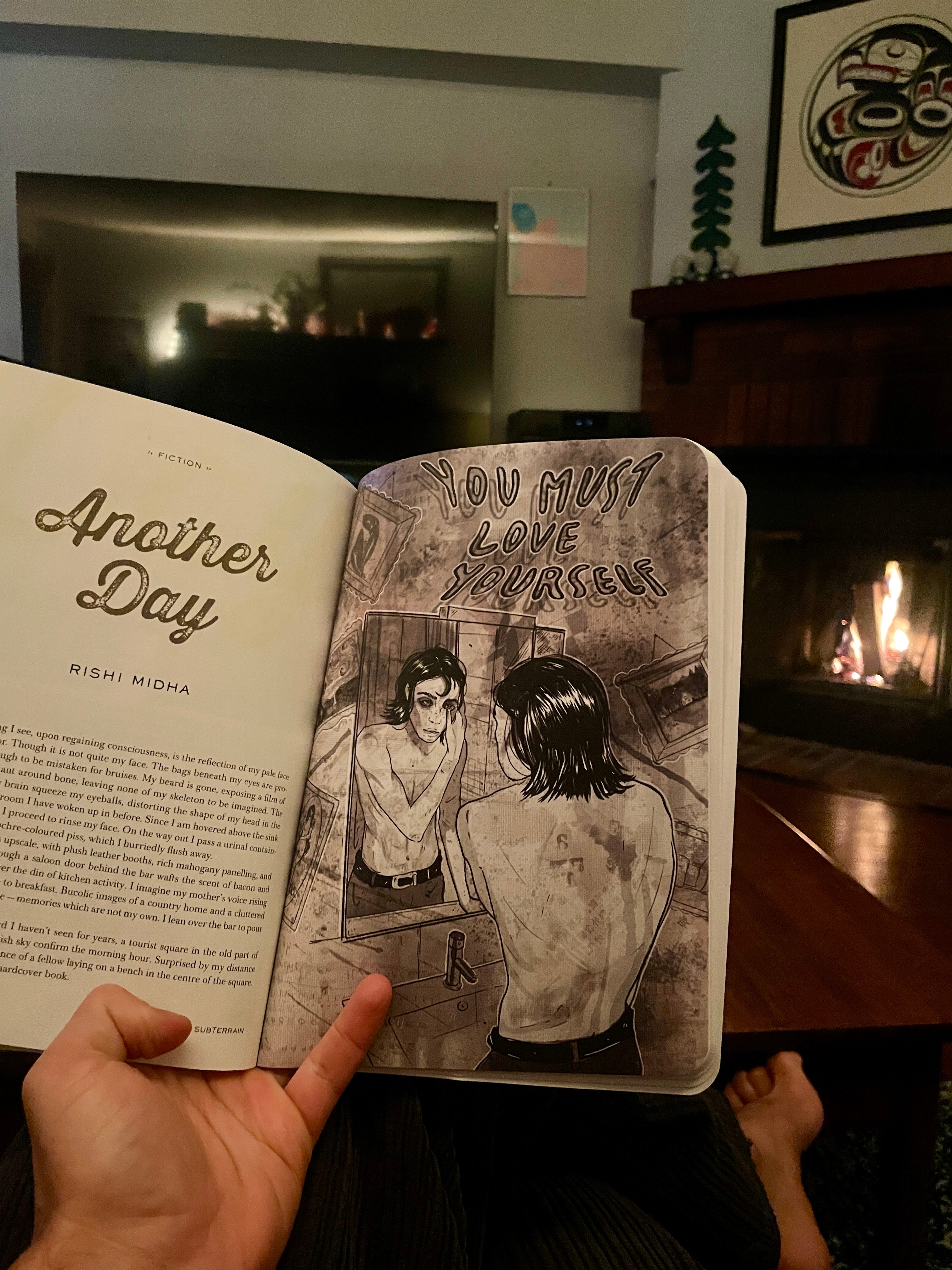
A snippet from my short story "Another Day", recently published in subTerrain's Dreams issue.

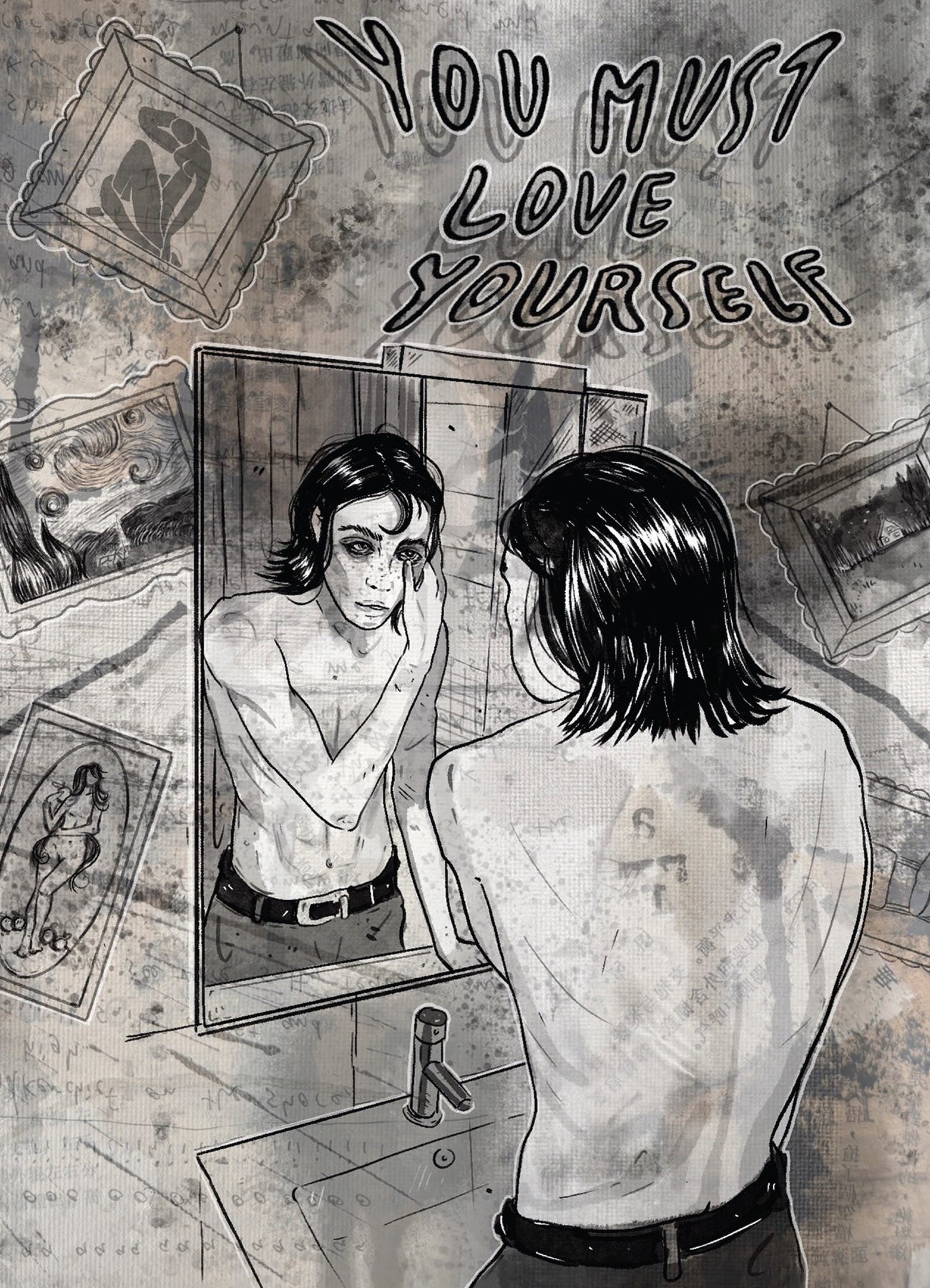
The first thing I see, upon regaining consciousness, is the reflection of my pale face in the mirror. Though it is not quite my face. The bags beneath my eyes are pronounced enough to be mistaken for bruises. My beard is gone, exposing a film of ashy skin stretched taut around bone, leaving none of my skeleton to be imagined. The swollen creases of my brain squeeze my temples, pushing my eyeballs out past their sockets. It is not a bathroom I have woken up in before. Since I am hovered above the sink and the tap is running, I proceed to rinse my face. On the way out I pass a urinal containing a pool of stagnant, ochre-coloured piss, which I hurriedly flush away.
The pub I emerge to has plush leather booths, rich mahogany panelling, and twelve beers on tap. Through a saloon door behind the bar wafts the scent of bacon and cheerful voices chatting over the din of kitchen activity. I imagine my mother’s voice rising above the clatter to call me to breakfast. Bucolic images of a country home and a cluttered kitchen and a whistling kettle—memories which are not my own. I lean over the bar to pour myself a pint and leave.
The bar exits to a courtyard I haven’t seen for months, a tourist square in the old part of town. A fresh breeze and pinkish sky confirm the morning hour. Surprised by my distance from home, I seek the reassurance of a fellow laying on a bench in the centre of the square. His face is masked by an open hardcover book.
“What’s the date?”
“Twenty-sixth,” he says, without removing the book from his face.
“Ah, my birthday.”
No reaction from the fellow.
I have lost track of my whereabouts for ten days, which seems excessive for any occasion. I place the pint on the cobblestone and walk away. After a few steps I turn back to see the bench fellow upright, reaching for the glass. Satisfied by this conclusion, I keep still and wait for the next chapter. The imposing façade of the national gallery looms over the courtyard, its scale causing it to pulse somewhat. I chuckle and stride towards it.
“Hello, Mr. Bains,” says Cheryl, who is standing by the door, doing as little as anyone else who works here. I peck her on the cheek and scurry towards coat check. The clerk accepts my sweater, along with my wallet, phone, and keys. When I remove my shoes and socks he frowns but does not object. As if trying to undermine everything I have just achieved, a lady hands me a map. I find a blue bin and hurriedly release it. I march up a staircase and through various labyrinths, maximizing distance from the foyer. The building is empty, the marble cold on my toes, the corridors generously spaced. Nothing encountered is accidental; everything exists for an aesthetic or functional purpose. I know they have done this well when I can hardly distinguish the two.
I am charmed by the very first painting I see: a nude woman and three oranges. The composition is arrogantly simple: five strokes on paper outlining her figure in black, a sparse wooden frame; a work that could be mistaken for a grade-school arts-and-crafts project. Before having to convince myself of its genius, I am standing on her balcony. Vineyards line the rolling hills against a backdrop of ocean and a strip of land in the distance—perhaps Morocco. In the gated area below is a manicured lawn patterned with the occasional orange tree, through which a gravel road winds. She waits beneath one of these trees. A salty breeze shakes an orange from a branch and into her basket. She turns to the balcony where I stand and screams in delight. I wake to the Matisse rotated 90 degrees (I have laid myself down) with her windswept laughter tumbling through the room and a dribble of spit on my chin.
Each return to sleep is a stroll through the vineyard, a soda on the balcony of her terracotta mansion, the ascent of a spiral staircase with her leading me by the hands, before I am plucked awake to a fresh bout of reality. Without opening my eyes, I dive headfirst back into the dream. Truthfully, the visits grow tiresome. Towards the end—we both know it’s the end—we lie naked in her sun-drenched bed and I offer her a warning: she is too content with her situation. Yes, each day is as idyllic as the rest, visitors will marvel over her perfect world for a time, but that is the beginning and the end of her existence. It is not a life to be satisfied with. She must leave! She must suffer. She must have a rotten life.
To this she giggles, though her radiant smile is disturbed. She shakes her head and the tension is flung aside like a speck of water. She prances into the vineyard with echoes of her singing voice reverberating through the valley.
I use my fingers to pry open my eyes. My body lays supine, facing away from the Matisse. In a corner across the room, framed by the sight line between my lifeless legs, an employee watches me from a white plastic chair. I crane my neck and his body stiffens. His immaculate sailor’s outfit and albino skin blend him with the white wall, his hair concealed by a white captain’s hat aside from two thick, pointed strands of black hair protruding over his forehead like an anime character. He raises his eyebrows, presumably an expression of concern for the man upon the floor. I lift my open palm and place my thumb against my forefinger. He nods and goes away.
I risk a final glance at the lady of oranges and am filled with shame for my parting words. Giving advice, especially to the young, is a despicable indulgence. A fool is anyone who claims to know anything.
The next room is the grandest I have ever seen. Beneath the domed ceiling is a sprawling black leather couch with a hard flat surface which could host a tentative game of bocce. I sit on the edge. A woman with a sketchbook and an oily plastic bag of olives (there are no rules in this world anymore) shares her sketch of an Otto Dix painting with my eye. I nod in approval, though I do not have an opinion. I notice my hand sliding around in her bag of olives, grasping for any single one. Her hand joins the fray. As our oily fingers flap against each other, I wonder about the centre of the couch—surely thousands have ventured there, but what is the point of crawling such a distance? The sketching woman does not stir as I attempt this. A streak of olive oil marks the length of my journey across the leather, which is smooth like stones in a river, eroded by the innumerable asses of bored children brought to the museum against their will.
I lie in the centre of the couch and stare into the glass cupula which magnifies the high sun. Glitters of dust float lackadaisically in the rays of light. I yearn for one of these beams to hook me by the sternum and lift me. I am always masquerading as a man living freely, but I would like to lead with the heart in earnest. My limbs could hang pointlessly, my heart forward, erect, my head pulled back by gravity, restricting my windpipe and putting my mind softly to rest.
This piece was recently published in subTerrain’s Dreams issue. I love this small, but mighty lit mag. They have given a home to some of my most utterly plotless writings, publications that led to my inclusion in the Best Canadian Stories 2026 anthology and my current book deal. They also commission custom illustrations from visual artists to accompany each piece—a rare thing nowadays. Please consider supporting them.
To read the full story, you can order a copy of the magazine in print (here) or digital (here). The piece will also appear in my story collection with Anvil Press, out June 2026.