I have concluded that the reason my memory sucks (it sucks) is because Everywhere I go, I am somewhere else. This may come as a surprise to those who have described me as “grounded”, or “present”, but the explanation is simple: when you never are where you actually are, an unshakeable stillness precedes you. The world you’re in, with its threats and impositions, is not the world you’re in; this makes it easy to appear at peace with the world you’re in. So please don’t be fooled by the façade; I am the antithesis of grounded, or present. Just now, I am transporting the sentences my friend is earnestly producing from a few feet away to a faraway place called Shame, shame for being somewhere else—but I’ve already left that land for another, call it Inspiration, because here is an idea for a piece of writing, which I’m sure will be relatable, about not being in the room my friend is currently talking to me in.
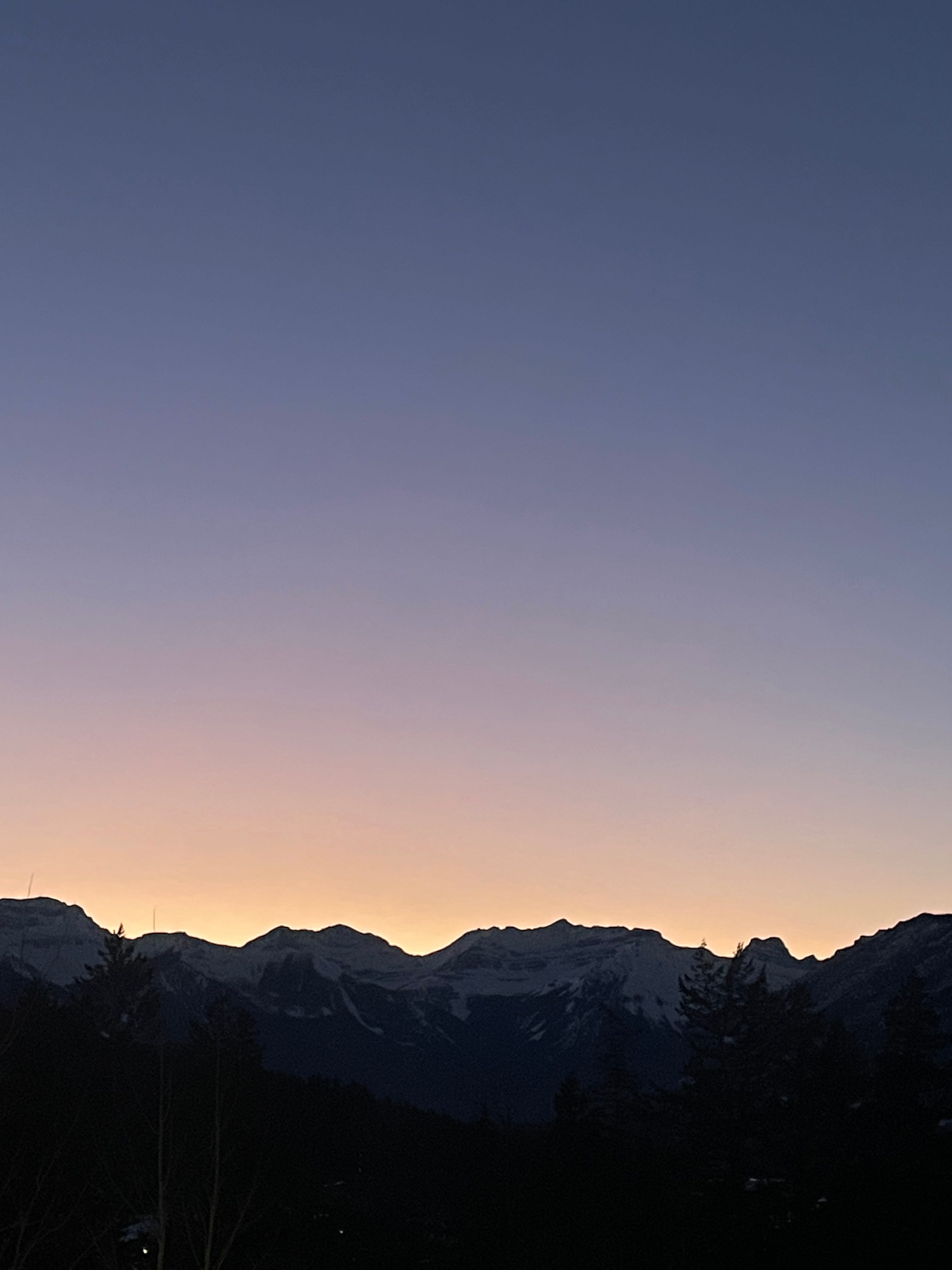
The first weeks of 2026 might have been exceptional, had I been there for any of them. They began with a ten-day chinook in Calgary. Chinooks are warm winds that blow east from the Rockies, suddenly raising temperatures by 10 to 20°C, peppering a harsh winter with several intermittent springs. Something about the science of them bestows the city with clear, blue skies, protected by a thick band of cloud (a chinook arch) holding steady over the mountains to the west. Dramatic sunsets filter through these cloud formations, providing a spectacle for their viewers paired with a much-needed surge of vitamin-D. This latter detail was the focal point of my chinook experience. I told my body: Get that vitamin-D, body. You need it. I placed the thing under the setting sun and shut my eyes, transporting myself to a meta-space in which I could feel the vitamins soaking into my skin, triggering a function in my nervous system that produces serotonin, making me happy—or at least affirming a sense that I could feel happy. I told my body to smile, and it smiled. I pulled out my phone to capture the sky and now I was not soaking in a pool of serotonin, but in a distant boardroom in which ten of me sat, each pitching a different use-case for this photograph: Instagram story, group chat, Sub stack note, trash bin, photoshop for touch-ups, or just leave it in my Photos album and share it with no one. A resounding Yes! to the latter. Keep it to yourself. The decision felt, momentarily, like a return to the present (me, happy, under the sun), but I left that place quickly to marvel at my present-ness, at having exercised the restraint not to tarnish the thing by broadcasting it online, at having successfully opted for the real experience.
Another January event I might have loved: my visit to the Banff Centre for Arts, to hear readings from the current cohort of writers-in-residence. A program I had applied to six months ago and been rejected from; or maybe I had been accepted and was arriving for day one of my residency—it doesn’t matter, you decide. You can’t be rejected if you are not, and were never, present under the spotlight to be scrutinized. I receive hundreds of so-called rejections in a year. By the time they arrive in my inbox, several months after submission, the work, and the person who wrote it, have been re-edited beyond recognition. These readers, publishers, evaluators, want to partake, for some reason, in the affliction of never being where they actually are, they want to go anywhere else, and they want other people to take them there. When you don’t deliver on that promise, they press reject. Sometimes they press accept, using abstract nouns like precision and authority to describe how well you wrote down the place you went to when you were not where you were. The success of this endeavour does not matter.
That’s the logic I was mostly inhabiting, recited glibly from the chair of a Charlie Rose interview, as I toured the Banff campus and poked my head into a few buildings, empty and silent given the dinner hour. Focus, Rishi—this is a sacred space, a campus for artistic indulgence carved out of a national park. To better grasp how sacred it was I populated the various rooms, behind closed doors, with the studio scenes from Kelly Reichardt’s film, Showing Up. Artists tinkering away at their obsessions, freed from a fundamental tension between the finicky demands of creative practice and life’s burdens constantly encroaching. I ended my tour at a top-floor cafeteria to watch the sun dip behind the Sundance Mountain Range, its silhouette framed by a crisp gradient, from peach to lavender—but did I really need to use peach and lavender? Orange and purple would suffice. The reader has seen a sunset, they will receive the data all the same. But peach and lavender conveyed more pastel-y hues that did, in fact, reflect the crispness of the winter night. I strayed a bit too long, amidst these wanderings, to take a worthwhile photograph of the sunset, let alone participate in it, whatever that means.
Another thing about Never being where you actually are: art has a tremendous sway on the places you inhabit instead of the place you’re in. As the writers-in-residence shared their work, I willingly handed off my command-centre’s keys to their poetic poems and prosaic poems and poetic proses and prosaic proses; keys I would never entrust to a living, breathing human. My body laughed and cried and loved and marveled, the tension between where I am and where I’m supposed to be briefly resolved, because in this room I am not supposed to be in this room, I am supposed to be where I actually am, which is within your wonderful art; thank you, readers—the work was authoritative. It was precise.
Later that night, I was not winding eastwards along the Trans-Canada Highway towards Calgary. I was rattling off a checklist of parameters: road empty, conditions clear, good album playing, and—lo and behold—the Aurora Borealis dancing in direct view of my driver’s window. The gravity of this moment was not the basic fact of a green, low-amplitude sine wave shimmering along the entirety of my trip, becoming especially bright in the Stoney Nakoda territory, where the mountains give way to rolling foothills; it was the realization that I had never once seen the Aurora Borealis and now needed to capture it, to own it. To lay down an anchor along the slippery slopes of a life.
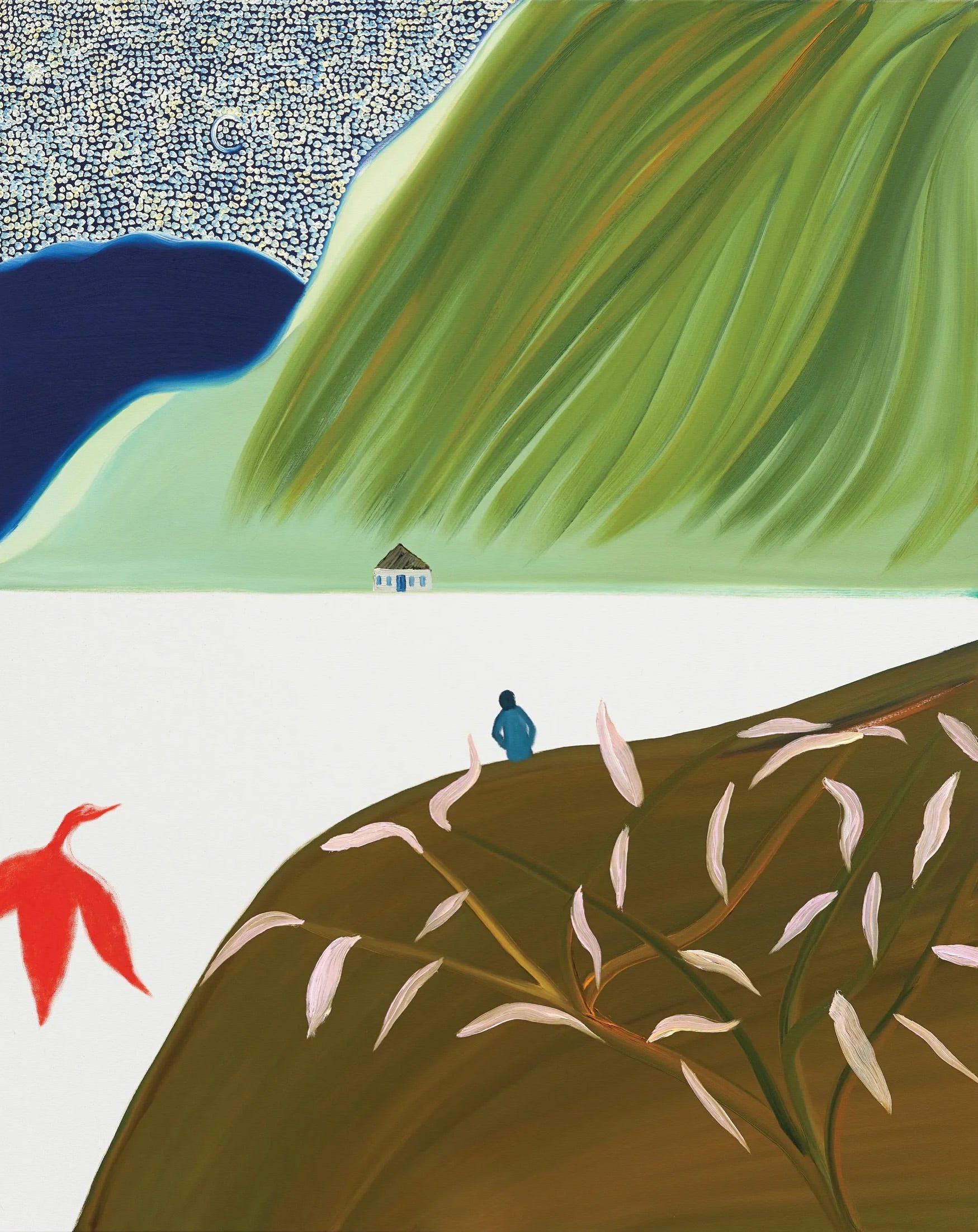
I pulled off the highway at an unmarked exit, parked in the middle of an empty overpass, and killed the headlights. I stepped into the cold to sit on the front hood of the car and watch the flickering greens, their staticky crackles and pops contrasting bizarrely with the hum of the highway beneath. This scene could be a government ad, I thought. It even has the diversity angle with me as the leading man. Come to Canada, immigrants! The American dream died in 1980, more nails enter the coffin every hour of every day; we’re not sure why they still bother hammering. You will love our safety net, your sons and daughters and in-betweens can pursue art and stare at the northern lights. They can lead lives so frivolous that their first concern, as they stare at the northern lights, is whether they are more attached to their “internal lives” or their “lived experiences”. And their next concern, perhaps, will be to wish they could paint mystical landscapes like Matthew Wong, or compose songs like Björk, or pen poems like Rilke, to illustrate what was happening before their eyes, wishing they possessed some precocious talent for subjective (mis)representation to bridge the gap between reality and its retelling—an effort that ultimately fails, and is pointless, but at least feels truer and less pointless than the failures spat out by our ever-improving gadgets, like the one that was in my hand, which was trying and failing to take a video of the Northern Lights.
I put my phone away. Surely I could find at least one abstract noun for the feelings being felt as my body beheld the spectacle overhead. The word was available, on the tip of my t—ah, yes. Grace. That’s the one. I couldn’t tell you an exact definition, but you know it when you feel it. I returned to my car and tried to watch the lights for another minute, but I was already gone, racing ahead to a room called Inspiration, where my body could sit down to write.