You'll Remember It Well

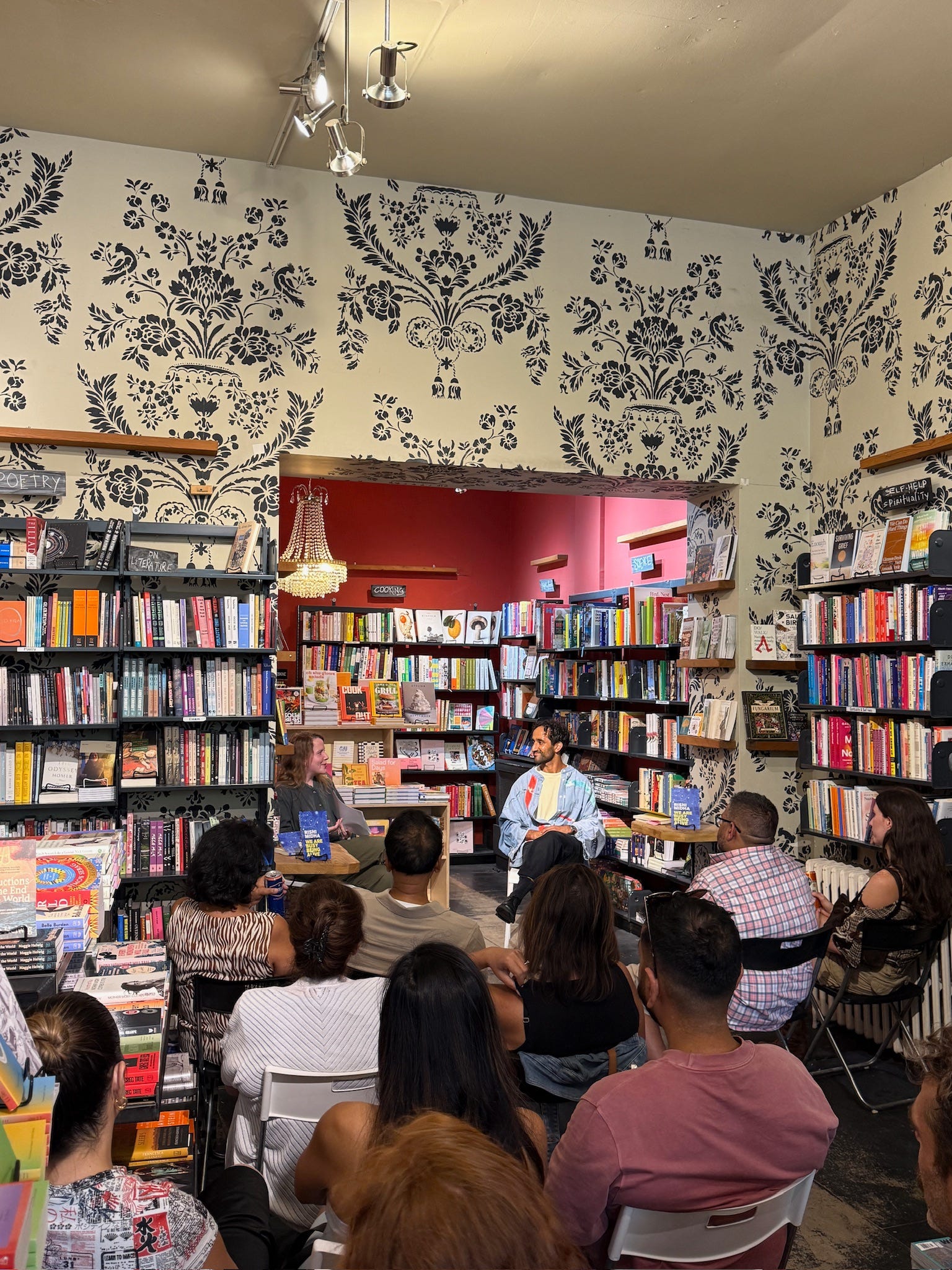
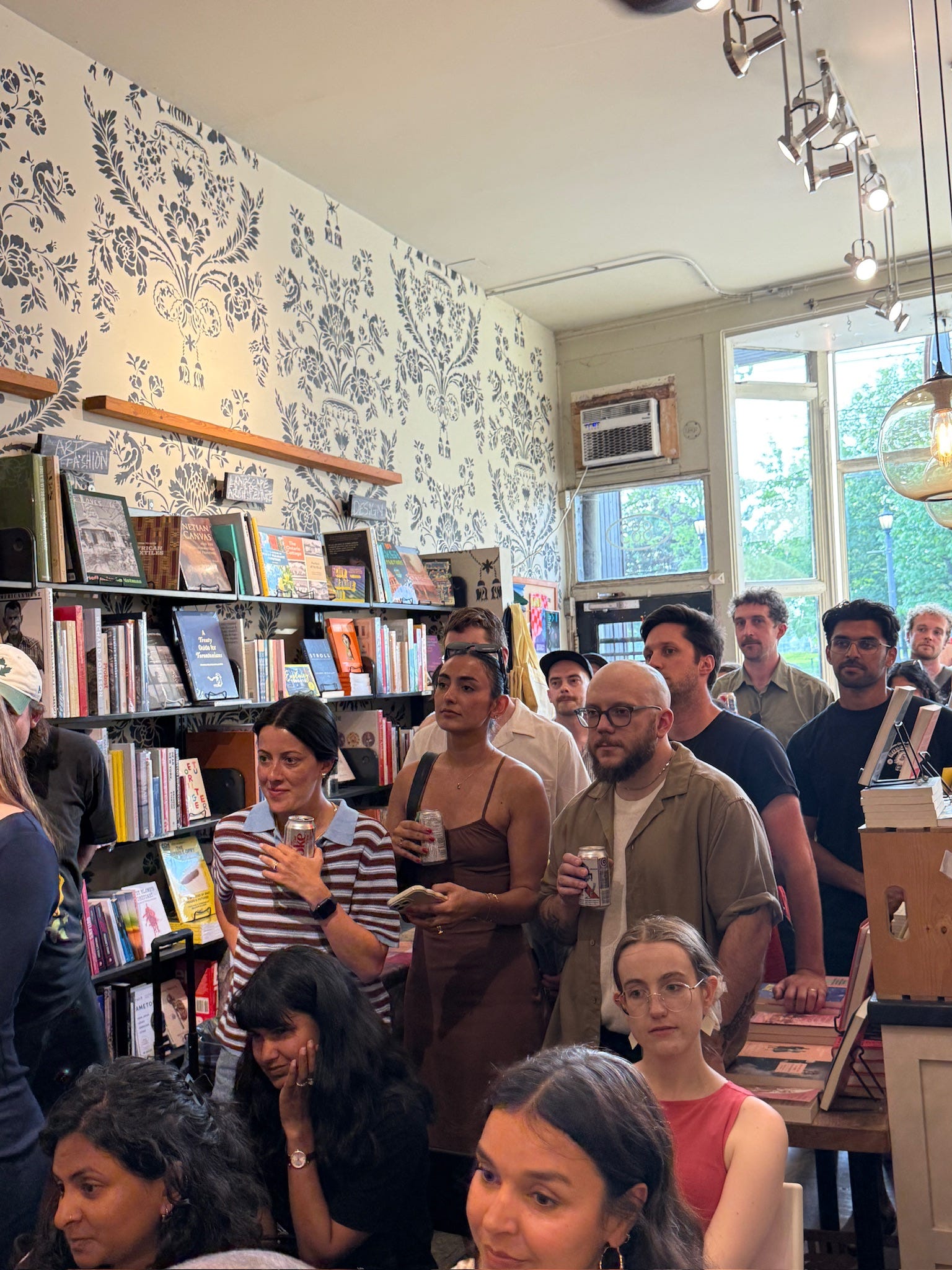
Sharing one of the shorter pieces from We Are Busy Being Alive, which was published July 1st (few pics from the launch at the end of this post!). You can order the book here [Canada] and here [US].
That was the summer when the world as you knew it consisted of twelve teenagers and a public outdoor pool. When it seemed plausible that missing a single shift—because you had the stomach flu, or your uncle died—could undo all the progress your thirteen-year project had thus amounted to. This significance was never spoken of or acknowledged; you were too involved in your life to insult it with words, the way grown-ups always tried to. They would see you bumbling around in a half-daze and think, perhaps fondly, He is so in love. And indeed, you were—but without any of the baggage they brought to such words. Your love was the extent to which your joy dissolved when Brian and Farah got the coveted job on the pool deck while you were stuck inside testing water samples. Love weighed down the desolate afternoons, when it was too hot even for swimming, and a thump on the head would jolt you from your slumber to everyone laughing; Jason was launching pine cones at the lifeguard chair to keep you awake. Love was the three-day high from placing your hand on Elena’s thigh in the dark office when the staff stayed after-hours for a movie, in the tensing of her leg and her guiding your fingers a bit further. It was the ten-day torment when she sat beside Mo for the next movie, the stillness of their bodies suggesting the same activity.
You will wonder, well into adulthood, if the memories from that summer have anything close to the same legacy for Elena, Jason, Mo, and the others. What’s the harm, you’ll ask yourself, from a desk chair on the seventeenth floor of a high-rise, in drifting off to the afternoon when you and Farah laughed for so many minutes that she puked in the wading pool, or to the ecstatic group embrace when you returned from a one-week suspension for pants-ing Jason right down to the nude? You’ll respond with the robotic logic you’ve come to despise. The harm is that you’ve failed to address certain facts about your present—a present in which the high-pitched cackles of your spontaneous laughter embarrass you, the temptation of a bold move dies a few steps into the decision tree, and every effort to re-acquaint yourself with the mischievous charm that once made your mistakes loveable to everyone, especially you, has fallen short. To retreat to that summer is to reinforce your past as the only solution to your present, to incessantly rehearse a tepid, unconvincing performance of your teenage self.
Another harm is that you’ll repeatedly fail to inhabit the places you actually are. An aloofness will precede you that you’ll blame for misplacing objects, and people. You’ll worry this is a symptom of age, despite only being in your thirties. There will be warning signs. You’ll sit down to pee at a restaurant, for instance, and accidentally position your penis above the edge of the toilet bowl rim, not noticing the pool of urine gathering at your feet because you’re inhabiting your teenage self. Eventually you’ll notice, adjust your penis angle, thanking God you’re in a cubicle and nobody saw. As the pool spreads beyond the cubicle’s confines, you’ll hurriedly flush and exit the restroom before someone arrives, wondering, as you wipe the soles of your shoes with a napkin, if any of this would have happened two decades ago.
Your daydreams will develop beyond the augmented past into the realm of pure fiction. You’ll have directed every line and camera angle of a film scene in which a teenaged-you sits on the train and a girl plops down on the neighbouring seat, wearing bunny ears and black tights and military boots. She’ll hug her backpack into her lap, scrunching up around it, and your body will scrunch up too. From across the train car, where the camera watches, we see two shy teens who have already fallen in love, with not a clue what to do about it. And toward that onlooker across the car, both boy and girl would shatter the third wall, staring into the lens as they break into faint, mischievous grins. The closeout song begins; something irreverent, cheerful, triumphant. There’s no harm in an active imagination, of course, you’ll be lucky enough to build an entire career around it; the harm is that this scene is the last one in your film—the story ends at age fourteen.
Each morning, around 6:00 a.m., with your espresso and silent journalling, you’ll find a brief window in which you can effortlessly inhabit your life. The sum of these mornings will nonetheless fail to dethrone that one morning, when you were still so in love, which you’ll always regard as the perfect morning. You had just returned from a long weekend at Brian’s farm. That alone was already the perfect weekend. Many of its scenes would be permanently seared into your brain. Elena’s eyes shut when she said I trust you, her chest grazing yours through her bikini top, so you smushed a handful of river sludge in her hair and she screamed and tackled you into the frigid water. The boys dangling from trees to shit in holes they had dug around the forest, honouring their chivalrous pledge to reserve the small septic tank for girls-only. Twelve bodies condensed into a tiny loft, getting traumatized by The Ring on VHS. You and Farah sprinting through the black field, screaming at every snap of a branch, sneaking into a tent to do nothing but lie there, terrified, wondering what you should do, because she was your best friend and you were hers.
But that was the weekend before the perfect morning.
It was a Monday back at the pool. The underslept shift was entirely unfit to guard the lives of the early-morning regulars: the guy who gave lessons, technically illegal in public pools, to a middle-aged couple; the old lady on the Muskoka chair reading vintage editions of classic novels (she once lent you A Tale of Two Cities, which you deemed overrated gibberish); the young man who did a laboured thirty laps, took five minutes to lie in the sun, then left in a hurry; the competitive swimmers who lapped the pool silently, without pause. From within the walls of your empire these were mere simulations of lives, their identifying qualities interchangeable, as if assigned from a drop-down menu. Their presence imposed a jarring conventionality upon the shift, an end to the weekend whose abruptness you were not ready to submit to. Naturally, the universe recognized this imbalance and sided with anarchy, summoning heavy winds that brought forth a torrent of golf-ball-sized hail. You and Mo were on deck when the storm hit. The supervisors rushed out to help you chaperone the swimmers to safety and start the close-out routine, but the hail became too heavy, so you joined the others inside. The crew was buzzing in the small office, animated by the chaos. Farah was dancing on a chair. You drew a wonky pair of breasts in the fogged-up window and Jason laughed. The Monday regulars huddled in a corner with their belongings, awkwardly surveying your kingdom, while the supervisors stared out the window and muttered to each other. They eventually turned to the crew and said, Screw it. We’re closed for the day. The room erupted in celebration, but you did not partake. Somehow you knew, with an instinct you would dismiss as arrogance today, that no one wanted to go home. You ran up to Cathy, who always had a soft spot for you, and said, “Can we?”
Can we? Can we? Can we?
It broke out in a chorus from the staff. The supervisors rolled their eyes, failing to conceal their smiles, and said, as if in practiced unison, Fiiiiiinnne.
The shift streamed out of the office like a line of infantry and crashed into the pool. Avoiding the bite of hail against skin was a test of who could stay underwater the longest. Shards of ice that breached the surface became bullets to evade. Two bigger splashes came from the supervisors—a rare, cherished instance of grown-ups sanctifying play. When the storm lessened a little, you were able to surface and continue a game that had never been organized or discussed, that had no rules, but you all knew the rules anyway. You’ll remember looking back at the admin office, the Monday regulars abandoned, watching the action, bewildered. And then being hoisted by your friends as if you’d hit a buzzer beater in Coach Carter, the hail splatting against your body with satisfying stings—all because you’d had the guts to suggest the idea. Your happiness in that moment flowed without friction or measure; it was just another entry in a long list of triumphs. You will anticipate your life achievements to surpass a playful romp in a hailstorm—correctly, no doubt—but no other will be received with such whole-hearted inevitability; for that reason the moment will be enshrined as your most heroic.
When the storm blew over, the supervisors realized, with disappointment, that they had missed the window to send everyone home. Of course, you weren’t bothered by it. Home was where your parents took shelter from a world which antagonized them at every turn (that day, it was the car windshield cracked by the hail). Home was a collection of overly cherished objects and arbitrary laws, within which you waited for life, and love, to resume.
But what is this love you throw around so flippantly? Seventeen years later, as a thirty-year-old, you’ll have plenty of words to muddle the meaning. You’ll know a love of partnership that you built brick-by-brick with your partner. When your niece says your name for the first time, a paternal love will strike to a depth that supplants you from the centre of your life. A love of writing will assail you more frequently than anything, though the reason it chose you, and its intentions for you, will never be revealed. A love fuelled by gratitude, a gratitude fuelled by regret, will emerge as your parents show their first signs of frailty. These loves will vie for your attention in a competition that lessens their potency relative to what you once knew as a singular, spontaneous love. You’ll leave the Buddhist temple on Wednesdays with the reassurance that love is not a zero-sum game, that tending to each channel into which you pour it will allow it to overflow. You will wait for this abundance. In the meantime, you will continue operating the delicate machinery that sustains your myriad loves. The demands of its motors are often such that you are too exhausted to appreciate when all is running well.
On rare occasions, like those 6:00 a.m. mornings, you’ll find a momentary pause to revel in the love you’ve managed to uphold. You’ll develop other habits that prolong this revelation, like your visits to the Buddhist temple, or exactly three ounces of good liquor, or, in the summer months, a Monday morning visit to the outdoor pool. A laboured thirty laps and a bask in the sun for five glorious minutes with endorphins coursing through your system. Before the work week begins, before your phone starts screaming and your partner’s pregnancy test returns another negative and your father’s care facility emails you the weekly report with the invoice attached, you will lie on a towel on the hot cement. You’ll turn your head lazily to the teenagers on lifeguard chairs, slouching around the admin office, exquisitely unaware of the preciousness of their hours, dizzied by the spell of the purest love. Because the machine is silent and all feels calm just then, you’ll resist the urge to describe it further. You’ll tread gently along tall fences at the perimeter of a feeling. You’ll remember the shape of it well.
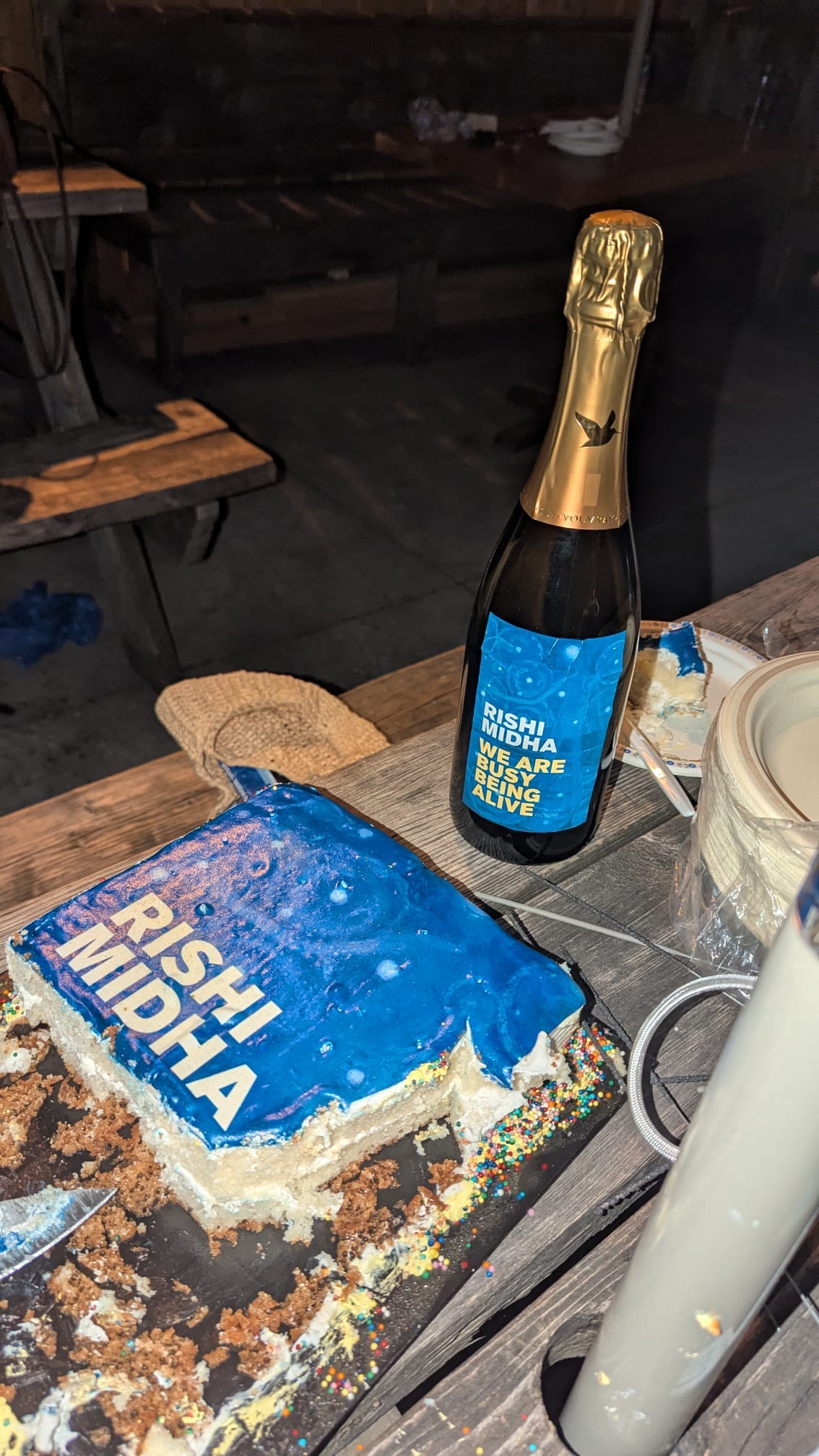
It was a treat to see many of you out at the Toronto launch! The night went swimmingly and I feel so supported.