

Give the art legs and the art will run
Equinox musings on Balint Zsako’s current exhibition, “Tango”, on now at Patel Brown Gallery.

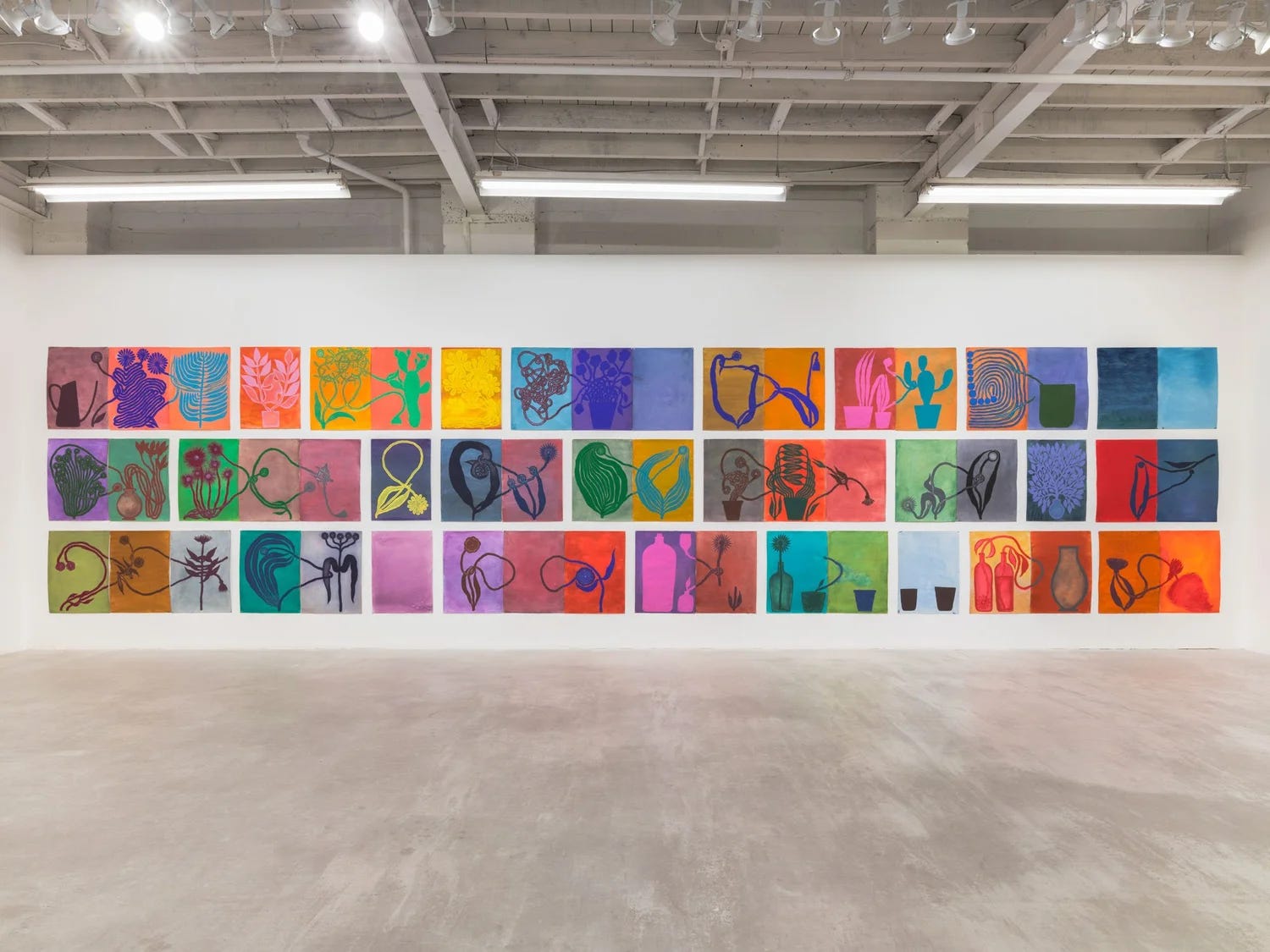
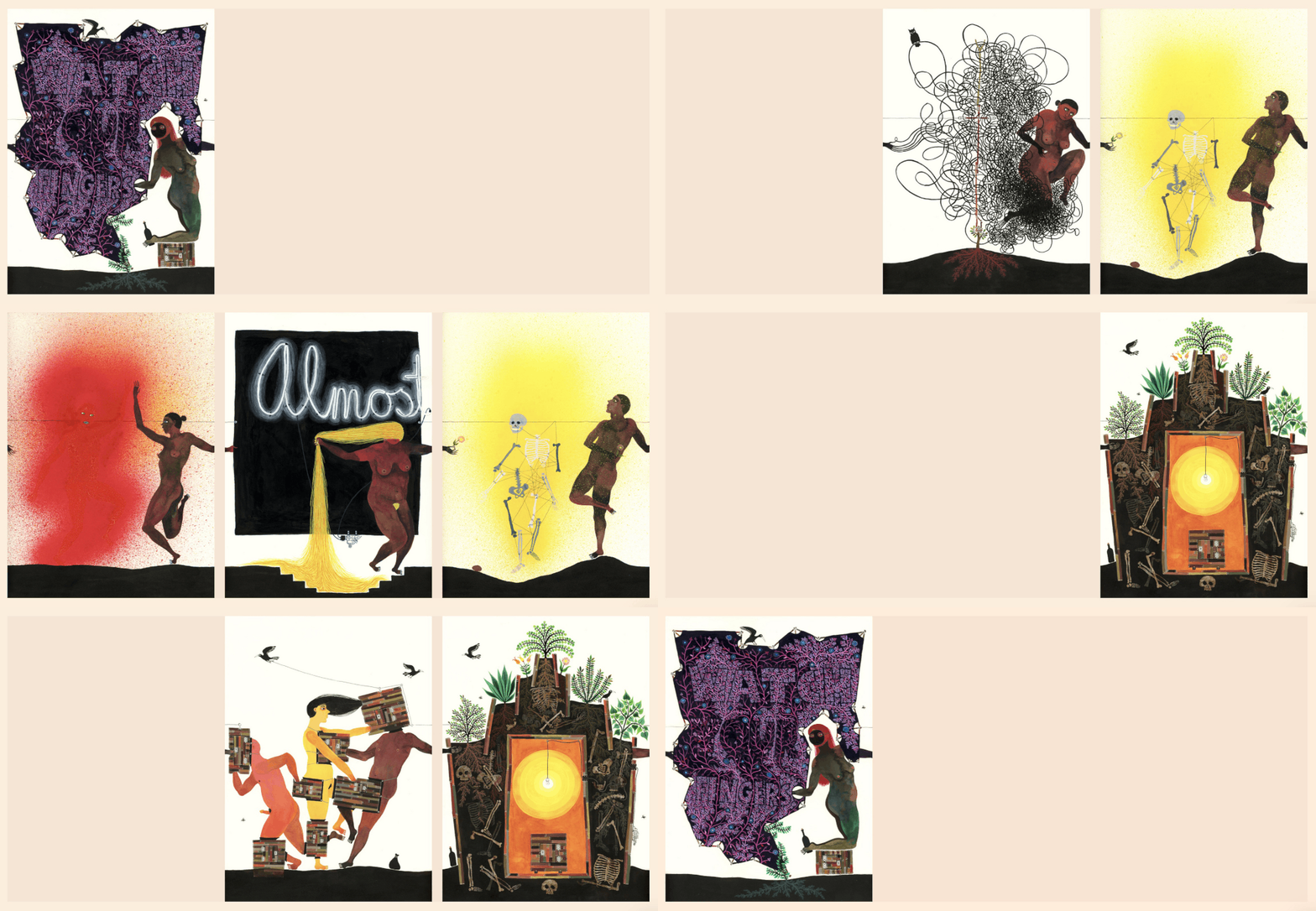
It’s important, if an art gallery has a bench, to sit on the bench. As I did so at Balint Zsako’s exhibition, Tango, currently showing at Patel Brown Gallery, I found myself hatching an experiment (this is why we sit on benches). In my experiment, 1,000 galleries would be sent the same 73 gouache and watercolour paintings, to be curated as they pleased. The connecting limbs that extend to the edges of most paintings, reaching for a partner, serve as control variables, of sorts: they make the arrangement of artworks interchangeable, so long as the pieces are shown in series.
Despite the near-infinite (1060 to 1080) permutations for the pieces to be arranged, it seemed plausible that a Fibonacci sequence would emerge across the 1,000 exhibitions. Perhaps patterns would be dictated by complementary colours or the rule of thirds. Perhaps they would vary by region. Perhaps the southern hemisphere, on the verge of winter, would sever the lines between buds, roots, and the vases which fed them.
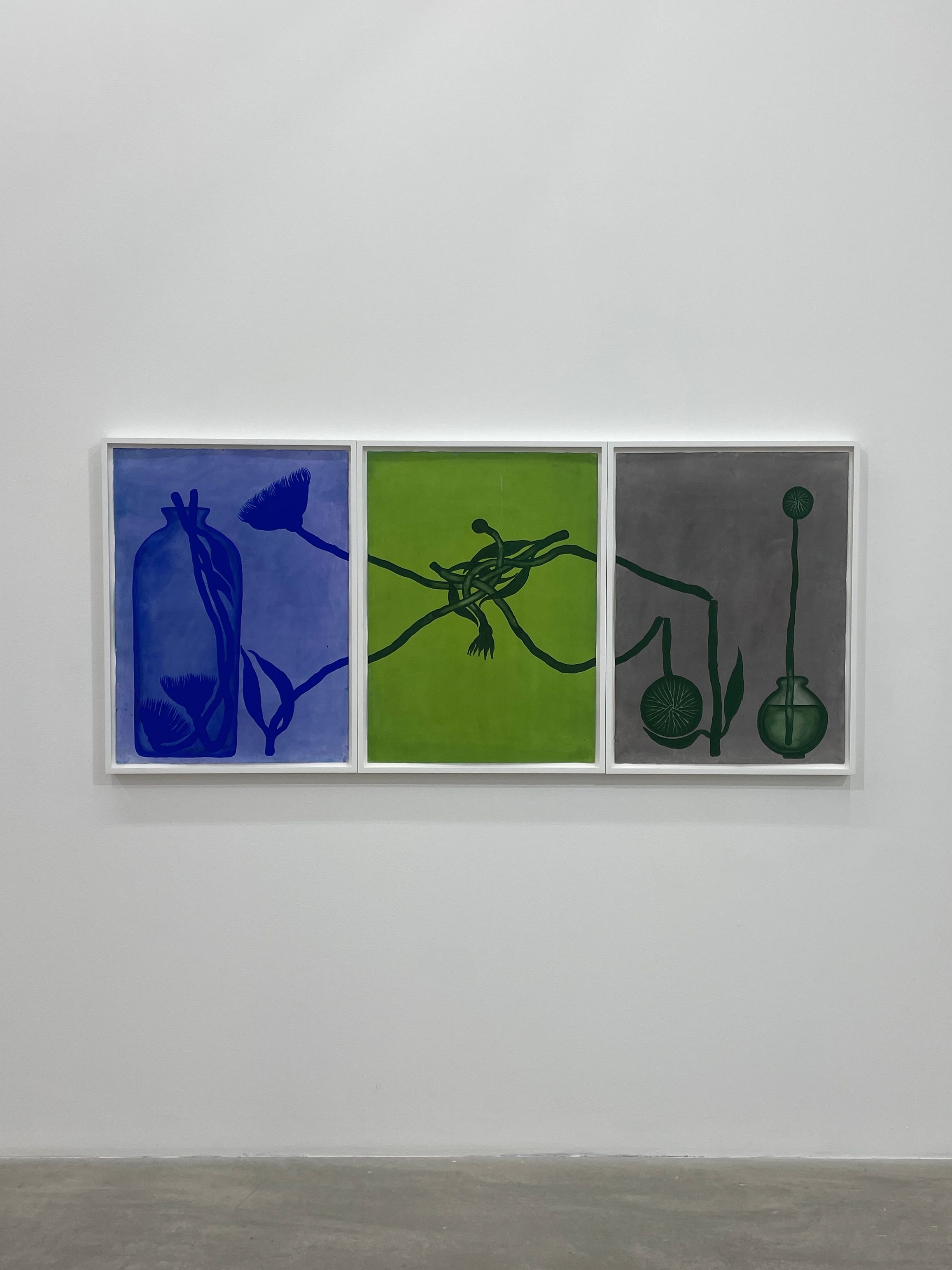
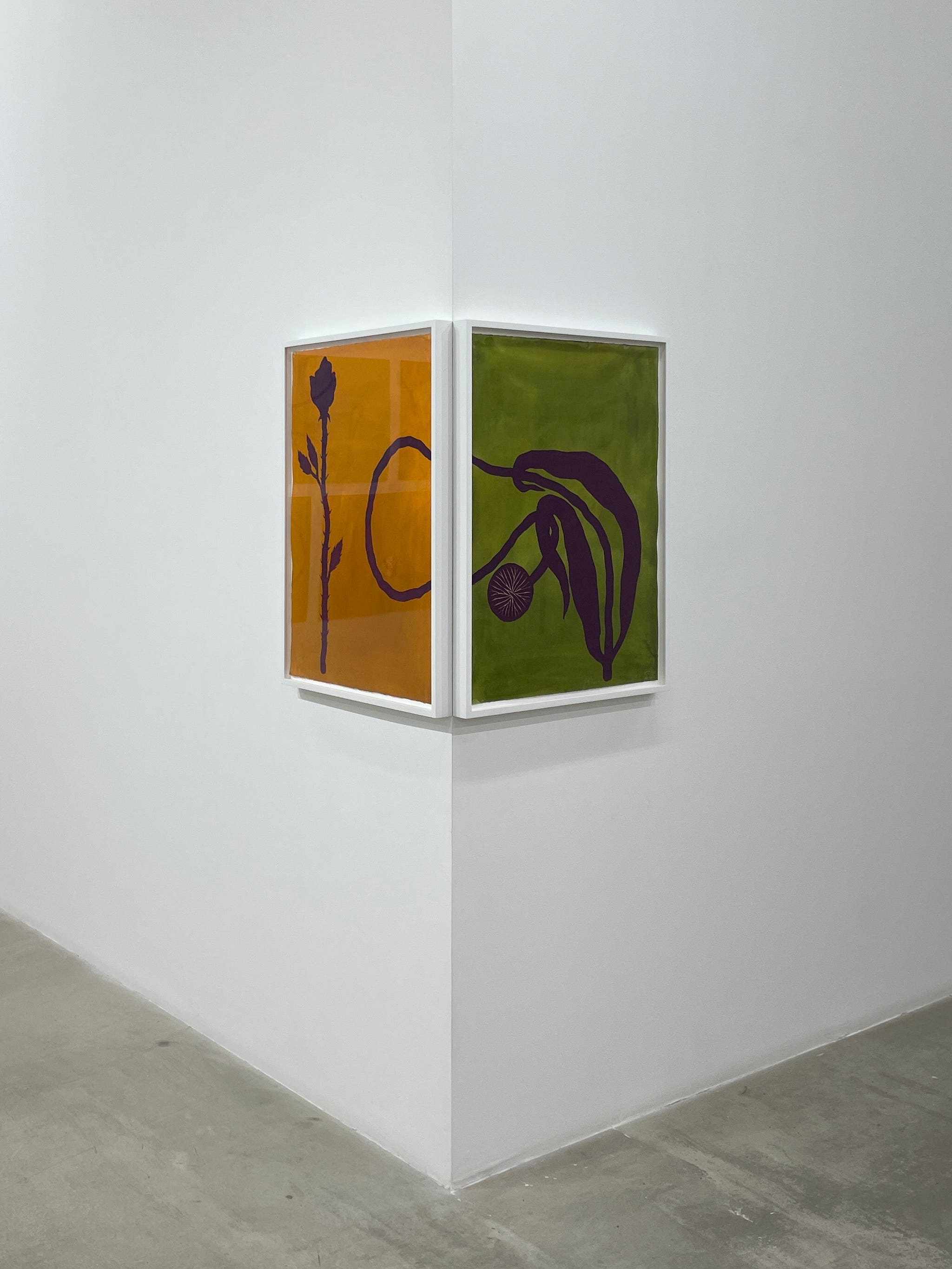
Art has no business telling you what to do with it; it merely reaches past its container, beckoning to be led elsewhere. As viewers, we crave to satisfy this ambition, approaching exhibitions like puzzles, not to “solve”, but to experiment and rearrange. My working arrangement of Tango—liable to be windshield-wiped across the floor and reshuffled—is that Zsako is encouraging this collaborative effort, between art and viewer, to find a moment of stability, one arrangement out of 1080, while acknowledging its fickleness.
The paintings, designed to be paired off and placed in series, reflect the task all viewers engage with when experiencing art. The modularity of their arrangement, meanwhile, undermines the impulse. The work is interchangeable; it refuses to be pinned down. You can make the art, curate it, own it, but you can never control its final destination; viewers forever cast their wobbly experiments, moods, and seasons upon it, as I am doing now.
I am inspired by artists, like Zsako, who let their art projects run wild, in a manner of speaking; a quality I hope to embrace in my creative output, and in the approaching publication of my book. One great appeal of my newest hobby, salsa dancing, is the constant reminder to let go. As a panicked beginner, I find myself wishing I could switch roles with my partner, put my hands out and follow along while the leader does all the thinking. This “doing all the thinking” mindset is precisely what makes me a stiff leader. Over-dictation zaps life from art, which only needs a few anchors between which it can move freely in the viewer’s mind. I’m made to think of a lovely excerpt from The Name of the World by Denis Johnson, during the narrator’s visit to a gallery:
This picture [...] was drawn with ink on a large white linen bedsheet and consisted of a tiny single perfect square at the center of the canvas, surrounded by concentric freehand lines. A draftsman using the right tools would have made thousands of concentric squares with the outlines just four or five millimeters apart. But, as I’ve said, the drawing, except for the central square, had been accomplished freehand: Each unintended imperfection in an outline had been scrupulously reproduced in the next, and since each square was larger, each imperfection grew larger too, until at the outermost edges the shapes were no longer squares, but vast chaotic wanderings.
To my way of thinking, this project [...] implicated all of us. There it was, all mapped out: the way of our greatness. Though simple and obvious as an act of art, the drawing portrayed the silly, helpless tendency of fundamental things to get way off course and turn into nonsense, illustrated the church’s grotesque pearling around its traditional heart, explained the pernicious extrapolating rules and observances of governments—implicated all of us in a gradual apostasy from every perfect thing we find or make.
Implicated. This wasn’t my reaction only. I talked with lots of people who’d seen this work, and they all felt the same, but in various ways, if that makes sense. They felt uneasy around it, challenged, disturbed. I suppose that’s what made it art, rather than drawing.
This excerpt perfectly captures how I relate to art objects as tools for speculation. In some cases, I don’t even see the art (sorry, artists); I gobble it up and disappear into my head. The art offers a few boundary conditions to daydream within—more boundaries than my fiction projects, to be sure—but when done well, it refuses to divulge too much. The objects are like buoys, bobbing in place, disparate, slippery moments of rest along a meandering journey. Knowing you have a safe place to land, between episodes of flailing, allows you to venture further, and more securely.
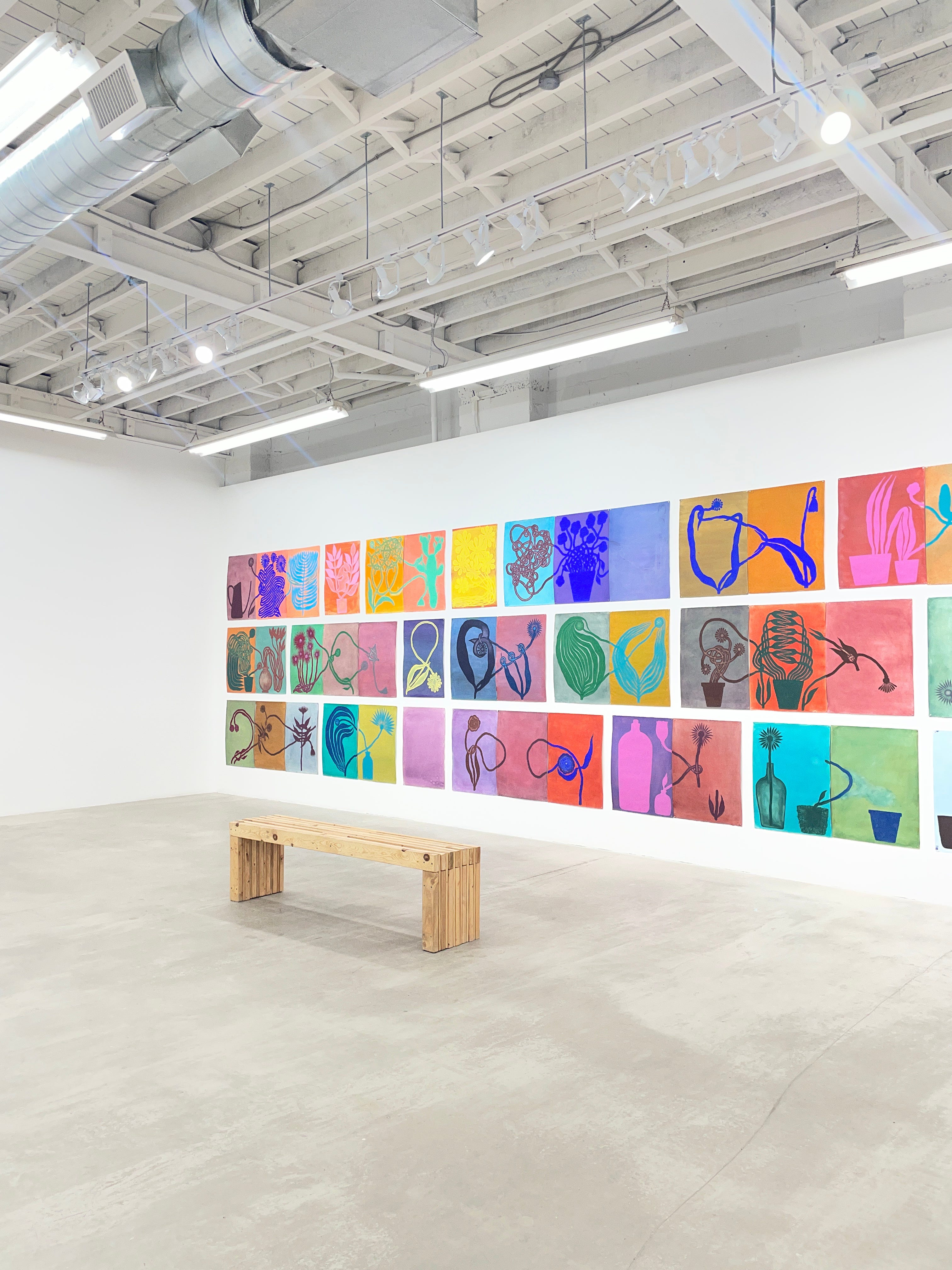
An art consultant, chatting with the gallerist near the bench where I sat, asked if she could take some pieces for a client before the show ends. No problem, said the gallerist. They have backups. They’d already rearranged the show a few times to accommodate sales. Finally! I thought, an exhibition that’s truly “dynamic”—an adjective you encounter in one out of five exhibition texts, since it scans without having to say anything. It made sense that paintings designed to be flexible, almost agnostic to their destination, were selling. Not to mention their other assets: off-kilter and whimsical without overstating those qualities; trusting the compositions to breathe; fresh palettes, instantly appealing, reminiscent of Matisse’s La Danse.
I rose from the bench with a headache. Three exhibitions is two more than I normally visit in a day. But this third one was rewarding. I sensed, cautiously, that I might even get to write about it. I started the hour-long walk home. It was a pleasant Saturday afternoon, the first day this year that felt like spring. Maybe that’s all the exhibition wanted to say, I thought: that spring is here, that the landscape is soon to come alive with vernal greens and ochres and violets. That, too, would be a fine way to arrange the puzzle.
I first encountered Zsako’s work through his series Modern Dance (2014-15), which also has a “modular” design. Here is a GIF of artworks from that series, which the artist designed to be rearranged on his website:
Related Reads
Speculations on Tristam Landsowne’s surreal watercolours:

On art that “transcends its form”:

