

We actually need more arts criticism
The ascendance of shallow or cynical arts criticism is the consequence of a popular mischaracterization and dismissal of critical practice, which can only be undone by a new generation of critics.

I was recently bait n’ switched by the viral-ish Substack post Anthony Fantano Should Not Be Famous. Most of the article reads exactly as expected: a disorganized rant featuring some well-trod grievances towards Mr. Fantano, the self-proclaimed internet’s busiest music nerd and our generation’s most prominent music critic. Had its scope stopped there, I would have frowned at its popularity then forgotten about it. But the switch came when the author, named Carm, extended her critique, rather boldly, into a categorical rejection of arts criticism as a profession.
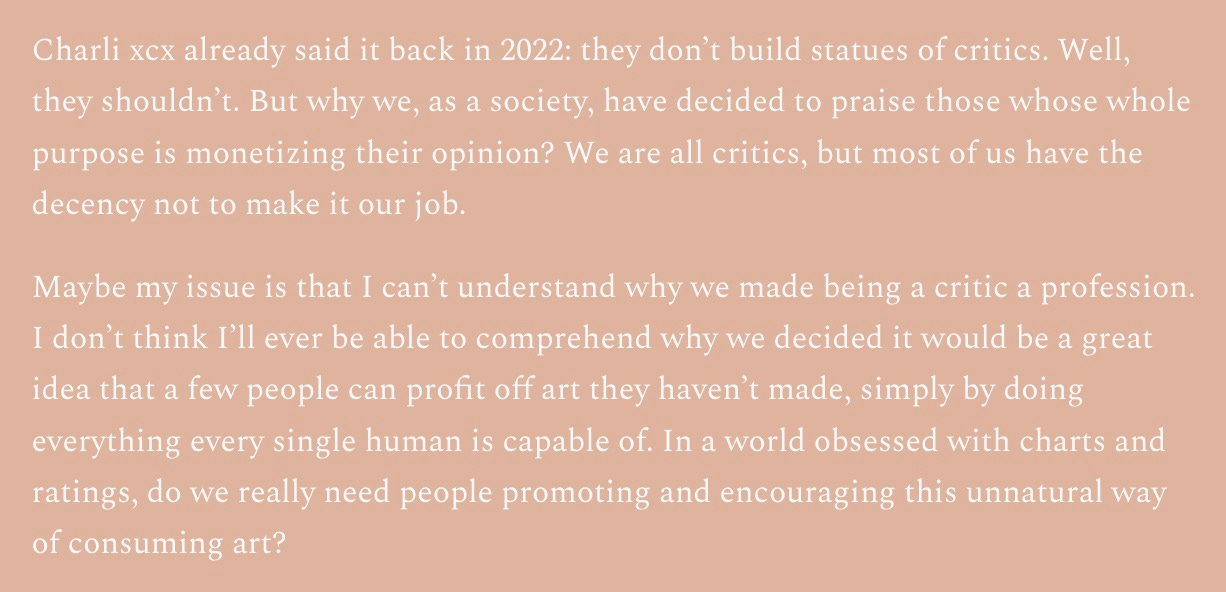
I’m not interested in picking apart this one post or starting a fight with one internet stranger. But the algorithm has served this tired take often enough to convince me that it’s a trending sentiment; now I must do the algorithm’s bidding by weighing in. In the populist fashion du jour, Carm’s post and others like it present a plausible villain (professional critics) as the culprit for a nebulous, but perhaps real issue (that individuals are increasingly not thinking about and relating to art for themselves). And despite Carm’s being the category of shallow criticism algorithms tend to reward—the very same type of criticism she takes issue with—I’m grateful she expressed her opinion and prompted this rabbit hole of reflection. That’s what criticism is all about!
Critiquing Criticism
To call criticism an “unnatural way of consuming art” is to misunderstand the critical instinct entirely, so this section is a bit of a back to basics.
Criticism is thinking critically and publicly about a thing. Art, like everything else we care about, has prompted a critical response for as long as it has existed. Individuals submit their responses into a bubbling cauldron (the discourse) and popular opinions and authority figures rise to the top, dictated by the power structures of the day: algorithms, governments, editors, and so on.
The debate of whether we should have criticism, and authority figures within it, is as pointless as asking whether we should think about stuff, and whether we should consider and promote thought that isn’t ours. The debate of which power structures are trustworthy and democratic in doling out authority, and how they seep into critical practice, is an important one, but has no bearing on the fundamental value of criticism. Upon accepting that there will always be arts criticism and a hierarchy of authority within it, we are left to debate the qualities of critical output that best serve art, and the criticism that’s therefore worthwhile to produce and give our attention to. These ideals are forever in flux, since criticism is a reflection of what artists, and the people who consume it, are grappling with in a given moment. For arts criticism to flourish, it demands a continuous critical response.
The popular rejection of professional arts criticism I most frequently encounter online tends to be blissfully unaware that it, too, is arts criticism, and it tends to be amongst the laziest examples you can find. Its typical approach is to cherry-pick criticism’s most popular format, the review, as a stand-in for an entire artistic practice. This is hardly surprising; reviews are the most attention-grabbing and accessible output. But many other functions, in addition to reviewing or judging, fall under the critical umbrella. More accomplished artists and critics than I have spent their careers exploring these functions. In reflecting on a few of my favourite excerpts below, I hope to establish a basic understanding of where the critical spirit originates from, and what, at its best, it can achieve.
“A critic is someone who loves experience. It’s a disposition that comes even before attention to art. [A critic is] someone that looks at any phenomenon […] and wants to extend their life by paying attention, by analysis, by juicing an aspect of experience for all it’s worth. Someone who is […] battling death by saying I can extend this moment […] by way of attention. The best way to practice that disposition [for a critic] happens to be on art. [The critic] uses their taste, their standards, their whole apparatus of judgement […] to express a kind of joy in being alive at the same time as the thing.”
— Vinson Cunningham
I love this quote, taken from the The Case for Criticism episode of The New Yorkers’ Critics at Large podcast, for three reasons. Firstly, because the critical instinct as Cunningham describes it should resonate with anyone who appreciates art, lowbrow, highbrow, whatever; it frames the critic’s effort as universal. Secondly, because of the verbs he chooses: looking, wanting, extending, analyzing, juicing, battling, practicing, using, expressing—which can mostly be categorized as visceral rather than intellectual, aligning with his broader point that criticism, though typically framed as an intellectual practice, is predicated on a visceral response, of being moved so deeply by art that further attention (intellectual or otherwise) is demanded. Thirdly, because you could substitute every instance of “critic” with “artist” and in either case, the quote would read as valid.
“Ours is a culture based on excess, on overproduction; the result is a steady loss of sharpness in our sensory experience. All the conditions of modern life—its material plenitude, its sheer crowdedness—conjoin to dull our sensory faculties. And it is in the light of the condition of our senses, our capacities (rather than those of another age), that the task of the critic must be assessed.
[…]
What is important now is to recover our senses. We must learn to see more, to hear more, to feel more.
[…]
Our task is not to find the maximum amount of content in a work of art, much less to squeeze more content out of the work than is already there. Our task is to cut back content so that we can see the thing at all. The aim of all commentary on art now should be to make works of art—and, by analogy, our own experience—more, rather than less, real to us. The function of criticism should be to show how it is what it is, even that it is what it is, rather than to show what it means.”
— Susan Sontag, Against Interpretation (1964)
Critical practice demands that its subject of focus reflects upon itself and invents fresh forms. It challenges the default tendency of a thing to play it safe and repeat. The critic’s own practice is not absolved from this demand.
In Against Interpretation, Sontag calls for critics to resist the popular temptation to assign value to art (its value is self-evident) by way of intellectually excavating its “content” (what it’s trying to say) from its “form” (the art object). People who respond viscerally to art, and who are thus disposed to performing criticism, per Cunningham’s quote, tend to be disillusioned by criticism that dictates the point of the art, or why the art is (or isn’t) intellectually valuable. Critics who rely on these functions emerge as authorities because those who lack a critical disposition—they don’t respond viscerally to art, or they are uncurious about, or unequipped to communicate, their response—desire a coherent something to say about the art, and the most accessible something is either what its point is, or a value judgement about it. To feel that you have cracked the “invisible code” of an artwork, or that you can deftly reduce it to a value judgement, is to have tamed the untameable thing.
Good criticism resists this behaviour. It is also difficult to produce and consume. If we want less reductive output from popular critics, we need to earn it. We need more people who care about art, like Carm, to develop their sensory muscles by themselves practicing criticism, thinking critically and publicly about art, how it makes them feel, and how criticism meets its needs. And then we need other critics, like myself, to respond. We need more critics.
“The antithesis between [the creative faculty and the critical faculty] is entirely arbitrary. [Through the] fine spirit of choice and delicate instinct of selection [...] the artist realises life for us, and gives to it a momentary perfection. Well, that spirit of choice, that subtle tact of omission, is really the critical faculty in one of its most characteristic moods, and no one who does not possess this critical faculty can create anything at all in art.”
[…]
“The critic occupies the same relation to the work of art that he criticizes as the artist does to the visible world of form and colour, or the unseen world of passion and of thought.”
[…]
“That is what the highest criticism really is, the record of one’s own soul. [The critic’s] sole aim is to chronicle his own impressions. It is for him that pictures are painted, books written, and marble hewn into form.”
— Oscar Wilde, The Critic As Artist (1891)
These three excerpts from Wilde’s The Critic As Artist illustrate how the faculties of the artist and the critic are inexorably linked, and that the broad way in which we describe the artistic impulse (a spontaneous, creative response to living) maps neatly onto the critical impulse (a spontaneous, creative response to experiencing art). Unlike a painting, or a novel, criticism has no strict medium or format: not a review, an abstract poem, nor a hundred-page essay; not an academic paper, nor a video breakdown, nor an off-the-cuff rant. Wilde argues that the critical act is thus more purely creative than the artistic act such as the painter’s or musician’s, given its lack of formal constraints. This latter contention feels less applicable in contemporary art than it would in 1891, but the broader point holds that criticism meets the qualifications of what we call art. Successful criticism, like successful art, expands perceptions and invites people to viscerally experience and inhabit its subject matter. And as in art, failure is a prerequisite to success. A thriving critical ecosystem demands that an overwhelming quantity of output fails to meet its ideals but keeps striving nonetheless.
I find writing arts criticism to be at least as creatively and intellectually stimulating as writing fiction. Since I am working with the output of a real person, I invariably take more care and responsibility in my treatment of the subject matter. My first instinct after reading Carm’s piece was to denounce it via a dismissive Substack note. But my visceral response suggested that some part of her argument resonated with me, or at least spoke to a grievance I recognized. Rather than setting out to dismantle the source material, I felt that the more critically honest task was to explore and contrast my own views on the topic.
What About “Bad Actors” Doing Cynical Criticism?
Perhaps these ideals of arts criticism read as naïve at a time where algorithms reward laziness, outrage, [insert any human quality platforms exacerbate minus the good ones]—qualities some bad actor critics are, no doubt, exploiting. But what they are really exploiting is a population that lacks a coherent value system for what to expect from criticism, and in many cases lacks even a working definition of what criticism is. Hence the previous section!
In holding critics to higher standards, we should be careful not to make the common error of conflating bad actors with critics who write negative reviews. The latter is an important function of criticism. Reflecting upon why art fails (from the critic’s perspective) helps a critic cultivate taste and better understand their ideals of art. Exploring a negative response reveals much about the critic’s sensibility; the output of a critic with no negative responses fails to convey a distinctive personality or an authentic experience of art1. Critics need both!
Importantly, however, a negative response should remain loyal to the material that inspired it. A bad actor critic designs their output around an audience response—outrage, pandering, whatever—rather than attempting to convey a sincere reaction to the source material. The critical practice strives to treat its source material (art) with the same unfiltered clarity that artists treat theirs (life), even when the source material lets us down. How do we measure the sincerity of a response? We don’t! I have no interest in telling Carm that her criticism was insincere or that she is deliberately a “bad actor”. All I can do is share my own sincere reaction, and hope that it is appreciated and heard.
Briefly on Fantano
I watch Fantano’s album / EP / singles roundups to discover projects that streaming algorithms would be unlikely to promote. One roundup put me onto the EP Twice Around the Sun by Ugly: an ambitious UK post rock or art rock band who became my most listened-to that year. Less frequently, I tune in for Fantano’s album reviews, typically for projects I already have strong opinions about. I am rarely wow’d by their depth of insight or originality—I doubt even he would disagree that his platform favours volume over depth—but I also don’t find them to be unintelligent or unfair. His ad-and-user-funded platform means he gets to review the albums he wants, including obscure projects that receive an order-of-magnitude fewer views than Taylor Swift or Kendrick. There is little reward for covering obscure projects, especially if only to shit on them; presumably he does so when he feels the work deserves a push. Should his popular content feel cheap, cynical, or click-baity, remember that it funds this passionate reporting which might more closely resemble what inspired him to start reviewing music.
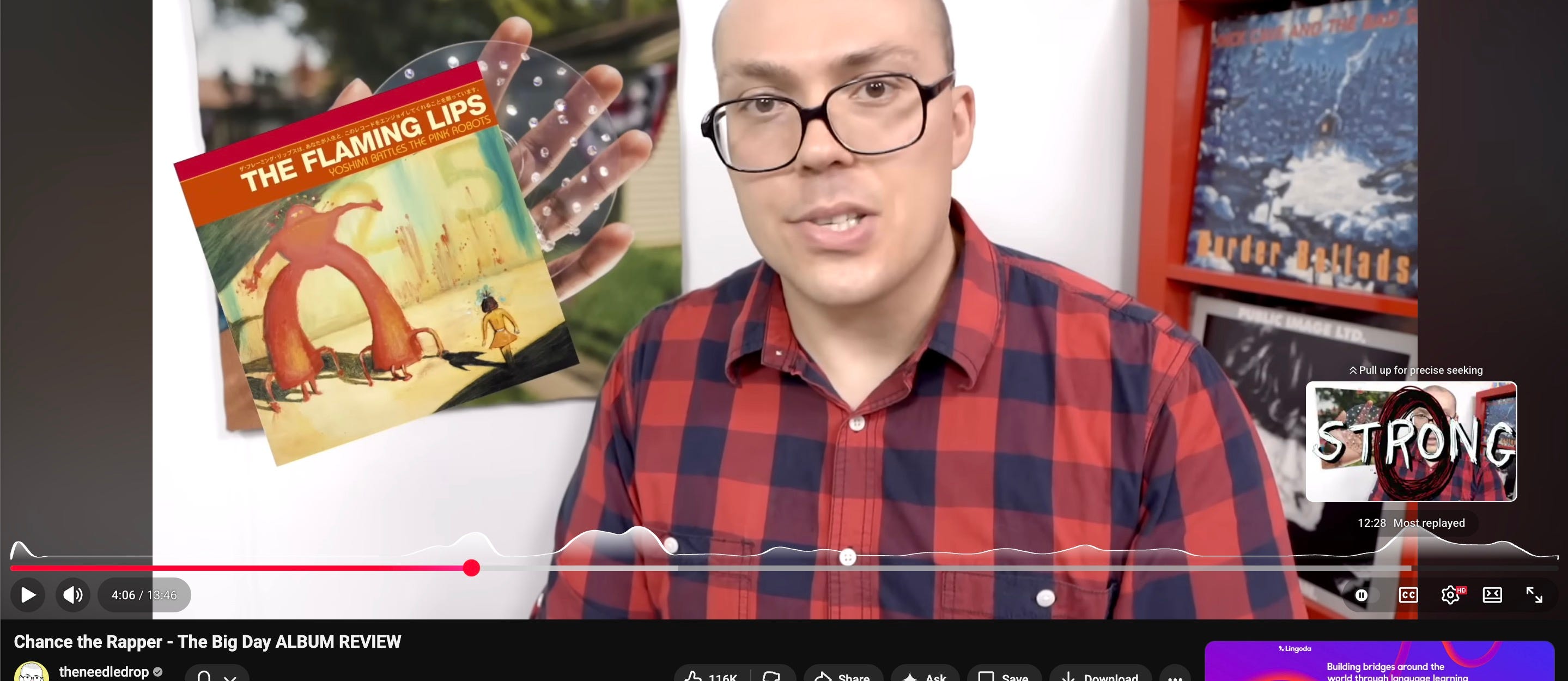
That does not mean I would call myself a fan of the melon. His ranking out of 10, reserved for the last ~twenty seconds of his videos, has become as central to his brand as his critical pans, which he often delivers with a sneer and a barely-concealed delight that make his face especially punchable. He spends anywhere between five and twenty-five minutes exploring his response to the work before revealing the score, but the knowledge that it’s coming at the end cheapens the entire product. His critique, however sincere, invariably becomes a justification of that final valuation which, in art, need not be made.
Luckily for us, there are other art critics doing more sensitive criticism, who don’t reduce art to rankings and have plenty of personality without being mean-spirited or taking (ostensible) pleasure from their negative reviews.
A Smattering of Arts Criticism I Like
If you’re not consuming good arts criticism, you’re not trying. It is readily available and published everywhere. Here are some examples from a quick browse.
God is in the Algorithm by Daniel Falatko [Substack]. Here the critic does a deep-dive on the career of NBA YoungBoy, an all-time top-selling artist in American music history who has remained invisible to a large swathe of mainstream listeners thanks, in part, to legacy media’s unwillingness to cover an artist who defies the narrative frameworks they rely on. This is an outstanding blend of journalism and arts / cultural / media criticism.
Notes on Emotionalism by Sophia Lapres [Public Parking]. I had to include some CanCon! Here the critic muses abstractedly upon the trend of “emotionalism” in art. Reflections on genre tends to be my preferred category of criticism, and the qualities of “emotionalism”—cutesy, indulgent, self-aware—feel especially relevant in art right now.
Drake, in Search of Lost Time by Benjamin Krusling [Paris Review]. Here the critic extends a depressing character portrait of Drake and the sterility of his music onto the culture he has become ubiquitous within, its averageness and low-grade disappointment functioning as a sort of realism that listeners—the author included—find themselves helplessly entangled within and taking pleasure from, paving the way for a likely never-before-attempted, but nonetheless satisfying, comparison of Drake’s oeuvre and Proust’s In Search of Lost Time.
Why Do Movies Feel So Different Now? by Thomas Flight [YouTube]. Here the critic explores the transition from modernism to postmodernism to metamodernism in popular cinema.
This random post by lavish_fragments [Reddit]. Here the critic does a conventional book review of Perfection by Vincenzo Latronico, finding much merit in the novel. While I wouldn’t call this groundbreaking criticism, nor did the review resonate (Perfection was, in my view, too committed to satire to feel human; the characters never felt like anything beyond symbolic stand-ins, which was clever and probably intentional on the author’s part since the characters, too, were striving, and failing, to become more than symbols, making the book a sharp and successful literary exercise but leaving no impression on me as a human), I felt it worthwhile to highlight because Reddit is “lowbrow” and anonymous. A high-effort post like this, sustained by passion and anonymous engagement, transforms the common jeer that “they don’t make statues of critics” into a source of pride, and perhaps criticism’s most admirable quality. The critical spirit alone is enough to sustain itself.
End
If we can accept that the practice of arts criticism—thinking critically and publicly about art—is hopelessly intertwined with art, and thus inevitable (and perhaps even essential) in a world where art matters, and we can also think critically about arts criticism to arrive at a set of critical ideals that best serve art, the question that will always follow is whether we are achieving that ideal in the present moment. We must never stop asking that question and promoting critics who take the time to answer it well! Without striving after ideals, art and criticism stagnate. Self-assessment promotes diversity and dynamism in art and thought. It’s what makes space for variation and genre, for lowbrow and highbrow art (and criticism). It’s what resists, rather than perpetuates, the homogenization of opinion and culture. Only in the last century or so has a modicum of diversity in racial, gender, and sexual identity entered the artistic canon. We owe this to the rise in diversity in both professional and layperson critical voices and the internet’s democratization of critical output. The problem of algorithmic amplification of shallow or cynical criticism can, similarly, only be undone by a new generation of critics who react and respond to the present.
So get to work, dear readers—or should I say, critics!

This could sound hypocritical as I have never published a negative review on welktober—but that’s only because it’s one of several projects I have on the go and with the ~1h a day I spend on it, I choose to write about work that resonates! If I were a full-time (hell, even a quarter-time) critic I would gladly write about art that takes me in unpleasant directions or, worse, fails to take me anywhere. If you want that to happen, pledge some $ to welktober :)