

When the Coffee is Ass
And other crises.

If you’re reading this (if you have enough free time to read random literary blogs, that is), you probably think of your life as being mostly characterized by goodness. If life can be thought of as a long rail path leading towards you-know-what, most of your hours are likely spent on a train called Good, gliding pleasantly, if not wistfully, through the countryside. But no one train can go on forever. After some months, or years—and without warning—you’ll feel your momentum slowing. The train will screech to a halt and a jarring announcement will ring through the AP system. The doors will open and the conductor will shove you into a crowded station called Bad.
Each time this happens, you’ll marvel at how decrepit and ugly Bad is, how quickly you forgot about its badness after you last left it behind. Like most people, you’ll do everything you can to avoid engaging with Bad. You’ll put on headphones, take pills, reminisce about the time on Good, employing an army of distractions and coping mechanisms until Good inevitably returns, at which point you’ll board the train without hesitation. You’ll notice, each time, as you pull away from the station, that a handful of people stayed behind on the platform entirely of their own volition. The calm resignation in their eyes will unnerve you, but after a few hours on Good, you’ll have forgotten all about those poor fools.
The crisis began two days ago, when I was at the coffee shop buying beans. I stood at the counter, my hand hovering over the bags of Sam James Butter Knife Espresso like a dowsing rod, and was surprised to find my fingers fingering towards an adjacent brand I’d not seen before. These mystery beans were housed in a brown bag with no details aside from “1 lbs” scribbled in Sharpie and a twenty dollar price tag. Twenty for a pound is unheard of in this economy, said my lizard brain. I threw one of the bags in my tote, pressed 0% tip on the checkout machine (the barista had not once lifted his eyes from the device in his lap), and bumped my phone against the machine at various angles until it made a noise.
The next morning I pulled an espresso shot with more anticipation than usual, eager to test out the new beans, only to discover that the coffee was ass. Flavourless, stale, difficult to extract; likely sitting on the barista’s shelf for weeks. My disappointment, though severe, was averted amid the busy workday and the long night of writing, and did not return until the following morning, when I woke in a state of dread. I generally enjoy waking up, but in this instance it did not seem of particular interest. The reward for my morning stretches and meditation is to sip coffee and write this journal. But when the coffee—the reward dangling on the other side of the effort—is ass, you approach the effort with the forthcoming ass-ness embodied; your stretches are a bit less stretchy, the current of your inhale-exhale is subject to rogue waves that send your thoughts spiralling, and with one thought in particular: when will this bag of ass coffee be finished with.
I am, as this journal knows, an austere man. I watch twenty-somethings with two functioning legs call an Uber instead of walking thirty minutes; I spy on the Amazon and Instacart packages arriving near-daily to my neighbour’s door, praying—for their own good—that they will get stolen; I feign interest while people boast about hotels I will never set foot in, in cities I will never visit; I compare the deepening of my friends’ slouches to my stiff spine as they drink five drinks in rapid succession; all the while I am thinking: Gluttons. Sleepwalkers. Pigs. Have they been successful in pretending away their discomfort? Don’t they know that their bones are made of dirt? That their skin, wrapped around their dirt bones, is an oily wall with little holes for spindles of protein to poke through and fall out? I return to patching my jeans, salvaging the few spoons of cottage cheese that aren’t rotten, waiting in the cold rain for the 63 bus to arrive (it never arrives; my socks are wet; I am very late). My only respite is this 7am coffee, produced by the few remaining objects of luxury in my household: an espresso machine, a burr grinder, the five-dollar barista oat milk. Fifteen minutes to sip and write and reflect on the chaste day ahead, propelled by the buttery mouthfeel of the cortado, whose foam-to-coffee ratio I have—no, wait. This coffee is ass. The balance is all off. My austerity measures no longer seem honourable, they are foolish. They are the reason I’ve fallen victim to this crisis; I chose the cheaper, larger bag of beans, which will take three weeks to finish, which I refuse to dump out early because that would make me as pathetic as the rest of the yuppies in this city.
On days eleven through fourteen of the ass coffee crisis, I distract myself by working on my Halloween costume. The project involves wandering the streets to collect fallen maple leaves in a garbage bag, focusing on those that have retained their bright reds and yellows and their platonic shape. Since the leaves are soaked from the week-long rain and I gave away my blow dryer, I collect them in a baking tray and bake them in the oven on the lowest heat. Then I attach a strip of double-sided tape to the backside of each leaf and paste them over every inch of a long-sleeve shirt and a pair of track pants, front and back, head to toe.
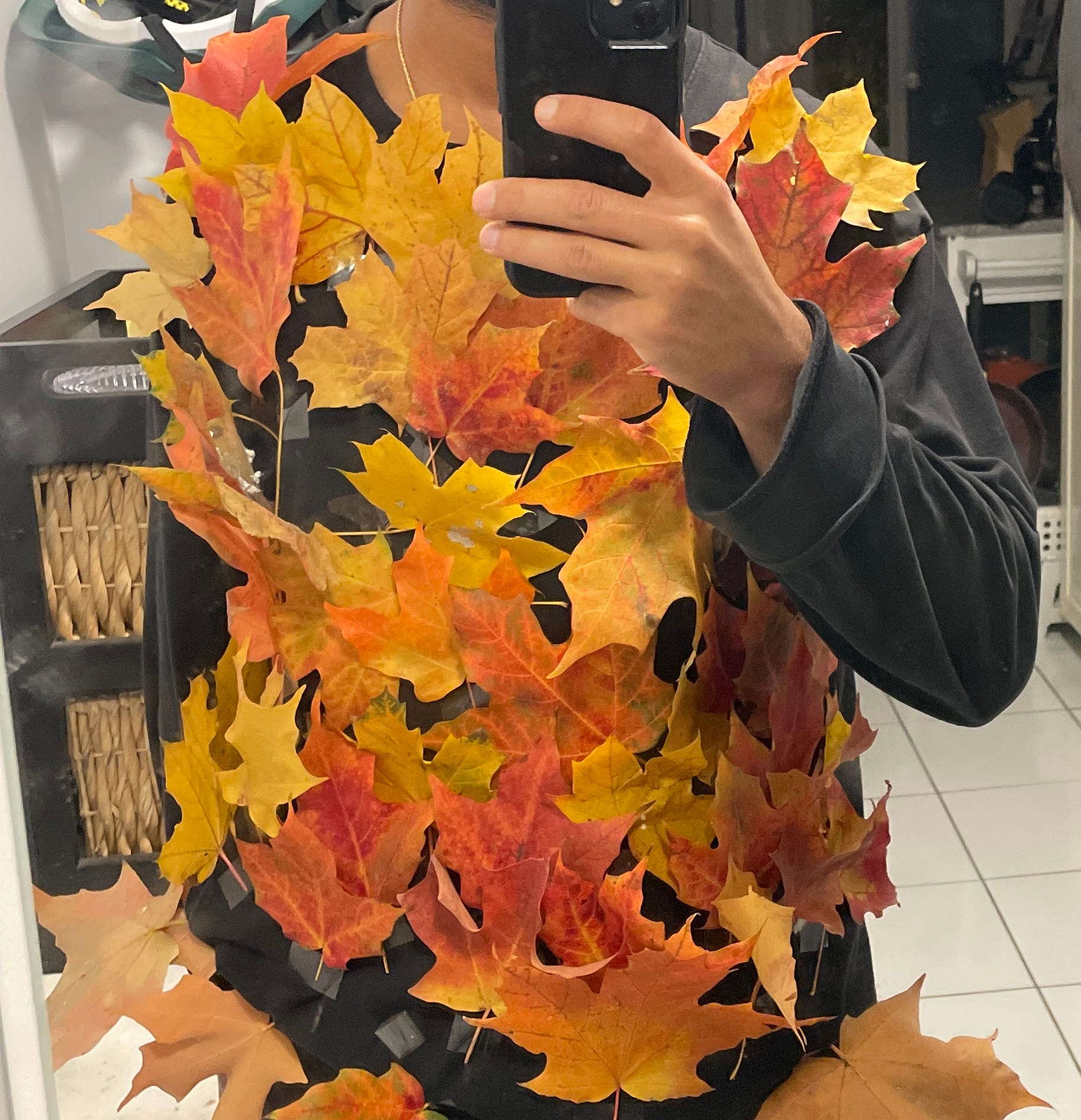
On Halloween eve, I gingerly poke my limbs through the arm and leg holes of the crunchy, delicate outfit, avoiding contact with the fabric like a game of Operation, then wait stiffly by the door with a bowl of Popeyes Candy Sticks until the doorbell rings, accompanied by a pre-pubescent TRICK OR TREAT. Two brothers stand before me. One’s costume is homemade and the other’s is store bought. I give two candy sticks to the former and one to the latter, who stares at his brother’s bowl with his mouth hanging open. Their mother, who stands behind them, tilts her head and frowns at me.
“What’s your costume, mister?” says the store bought kid.
I look down at my costume. Somehow, I had not anticipated this question.
“A bush.”
“A bush isn’t scary,” says the other kid.
“Tell that to Iraq.”
The mother frowns again and steps closer to her kids.
“Or a sixteen-year-old boy.” I couldn’t resist.
The whisper of a smile appears on her lips, then disappears. She asks if I forgot to give Jason a second candy, using that tone parents use with kids who forget to say Please and Thank You.
“No,” I say, mimicking her tone, “I did not.”
My candy supply runs out after fifteen visits, as calculated. For the rest of the night, when the doorbell rings, I open the door and turn my empty bowl upside-down. “Tough luck, kiddos.” They whine, they scowl. One parent asks why I bothered answering the door. Someone needs to teach these brats that not every cry for help will be answered, I want to say, but I keep my mouth shut and shrug.
The pound of ass coffee gradually depletes, in the ensuing days, without a word of my complaint—aside from this journal—and by day eighteen of twenty-one, the early days of despair are a distant trauma. I feel grateful for the two weeks of deprivation, a divine intervention which has allowed the pleasure of my existence to descend yet another rung on the ladder of inconsequentiality, from hot bean water to the lesser luxury of Butter Rice. I boil four cups of rice in a large pot, then fold in a stick of butter and a few teaspoons of salt. Whenever I need to reawaken myself to my life, I heat up a few scoops of the Butter Rice and eat it with the tiniest spoon I own, one of those cocaine spoons from my old days of hedonism, or, alternatively, I eat it grain-by-grain with chopsticks, luxuriating in the procedure.
The lewd decadence of the pre-ass-coffee days has faded away entirely by day twenty.
On day twenty-one, I am back at the coffee shop. Laid out before me are the same two options: the all-caps, black-and-white, sans serif text of the Sam James; the nondescript paper bag of ass. I stand there staring at them for much too long. The barista watches me without interest as I weigh the options, though I am not really weighing. My mind is vacant, pleasantly numb, noticing, instead, the familiar ebbs and flows of the coffee shop. The purging of the steam wand, the hollow tapping against the knock box, dim chatter, girls giggling, Gymnopédies through the speakers, the homeless man who always stops by for a free cup of coffee, who is now standing beside me as I consider the beans—but I am not considering, my mind is made. I do not touch either of the bags.
“I’ll have a hot water with lemon, please.” My grandmother’s classic order. The most severe woman I ever knew.
“A what?”
“A hot water. With a slice of lemon.”
“We don’t have lemons.”
“Just the hot water then.”
The barista pours me a cup of hot water. I tell him to charge me for the homeless man’s coffee and punch in a 10% tip on the checkout machine (he briefly lifted his eyes from the device in his lap), and bump my phone against the machine until it makes a noise. I sip the hot water—which is not ass—during the short walk home, enjoying the autumn leaves. I continue sipping as I transport the espresso machine, the burr grinder, and the barista oat milk from my kitchen to the curb.
The air in the kitchen feels lighter upon my return. I am struck by a desire to fill the newfound spaciousness with some form of pollution. It doesn’t matter what it is. I could scurry back outside to reclaim my so-called possessions. I could play the new Rosalía single my entire generation is gushing about as if they recorded it themselves. I could power swipe on Hinge, making tens of split-second decisions on whether the five details summarizing her life are worthy of the five summarizing mine. I could spend my desire on more desire, logging on to anywebsite.com to browse the images, each of which is not worth a thousand words, but only five, the five words being YOU ARE NOT SUFFERING ENOUGH, with a like or a checkout button beside them. I chuckle at these possibilities as I sip the hot water and spoon some Butter Rice into a bowl. As it warms in the microwave, I sit alone in the spaciousness, doing nothing.

I can totally hear Gymnopédies playing as the anthem of this essay
A bush. The clapbacks. Genius.